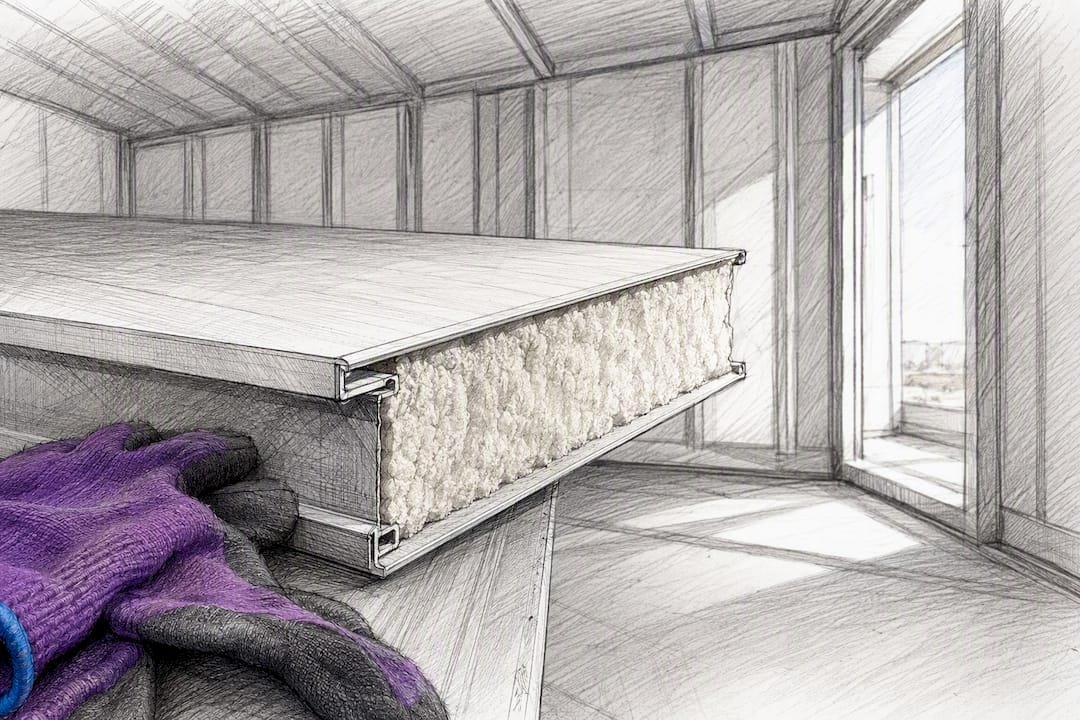
For most modular projects, PU/PIR core panels at 100 mm thickness handle standard rooms and offices, rockwool takes over wherever fire codes are strict, and EPS covers budget builds where the climate is mild. Cold storage or freezer units need 150 mm PU/PIR minimum. Before you buy anything, get the supplier’s core density certificate and fire classification in writing.
TL;DR:
- Ensure core density reports and fire certificates are obtained before purchase; low-density foam panels can significantly weaken insulation and structural integrity.
- Know that PU/PIR delivers the highest thermal performance per inch, especially valuable in tight spaces or extreme climates, with long-term R-value drift possible.
- Recognize that EPS is suitable for budget projects in mild climates but performs poorly with strict fire codes or in cold storage applications due to its fire vulnerability.
- Match panel thickness and density carefully to your climate and thermal needs, avoiding under-spec materials to prevent performance losses.
- Prefab kits combining core, facing, and joints reduce installation errors and mismatches, streamlining installation and avoiding costly rework.
Table of Contents
- What Are the Best Container Insulation Options for Different Projects?
- How Do You Spec the Right Panel Thickness and Density?
- What Should Buyers Check Before Ordering Container-Style Panels?
- What Installation Mistakes Hurt Thermal Performance the Most?
- Why Integrated Panel Kits Reduce Specification Risk
- Ready to Order? Here’s What to Prepare First
- Where Container Insulation Choices Land in Practice
- Sources
What Are the Best Container Insulation Options for Different Projects?
The right core material depends less on brand preference and more on three questions: how cold does it need to stay inside, does your local code demand a specific fire rating, and how much wall thickness can you actually spare. Three core families dominate the sandwich-panel market, and each solves a different version of that problem.
Expanded polystyrene (EPS) costs the least per square meter and works fine in temperate climates where you’re not fighting extreme heat or cold. Its thermal conductivity runs 0.030 to 0.038 W/mK, which is respectable but not class-leading. The tradeoff is fire performance: EPS burns more readily than the alternatives, so it’s a poor match for anything with strict fire code exposure. Budget worker housing, temporary site offices, and short-lifespan modules are where EPS earns its keep.
PU/PIR (polyurethane/polyisocyanurate) delivers the best thermal performance per inch of any common core, at 0.022 to 0.028 W/mK. That efficiency matters most when interior floor space is tight and you can’t afford a thick wall assembly just to hit your insulation target. SIP-style PU/PIR panels can start around R-6.0 to R-7.2 per inch, though that number tends to drift down toward R-5.0 to R-6.5 over years of service. It’s still the strongest thermal performer in the category, and in extreme climates it can cut operating energy costs by 20 to 30 percent compared with EPS.
Rockwool is the one to reach for when fire rating and sound control both matter. It’s non-combustible, which makes it the practical choice for A1/A2 fire classifications, and it handles acoustic performance better than either foam option. The catch is weight and thickness. You’ll often need a heavier, thicker panel than PU/PIR to hit the same R-value.
- EPS: lowest upfront cost, moderate thermal performance, weaker fire behavior
- PU/PIR: best thermal efficiency per inch, strong moisture resistance, some long-term R-value drift
- Rockwool: non-combustible, best acoustic control, heavier and bulkier for equivalent insulation
How Do You Spec the Right Panel Thickness and Density?
Turning “I want good insulation” into a request for quotation means putting real numbers on paper. Thickness, density, facing, and joint type all belong on that document, not left to the supplier’s discretion.
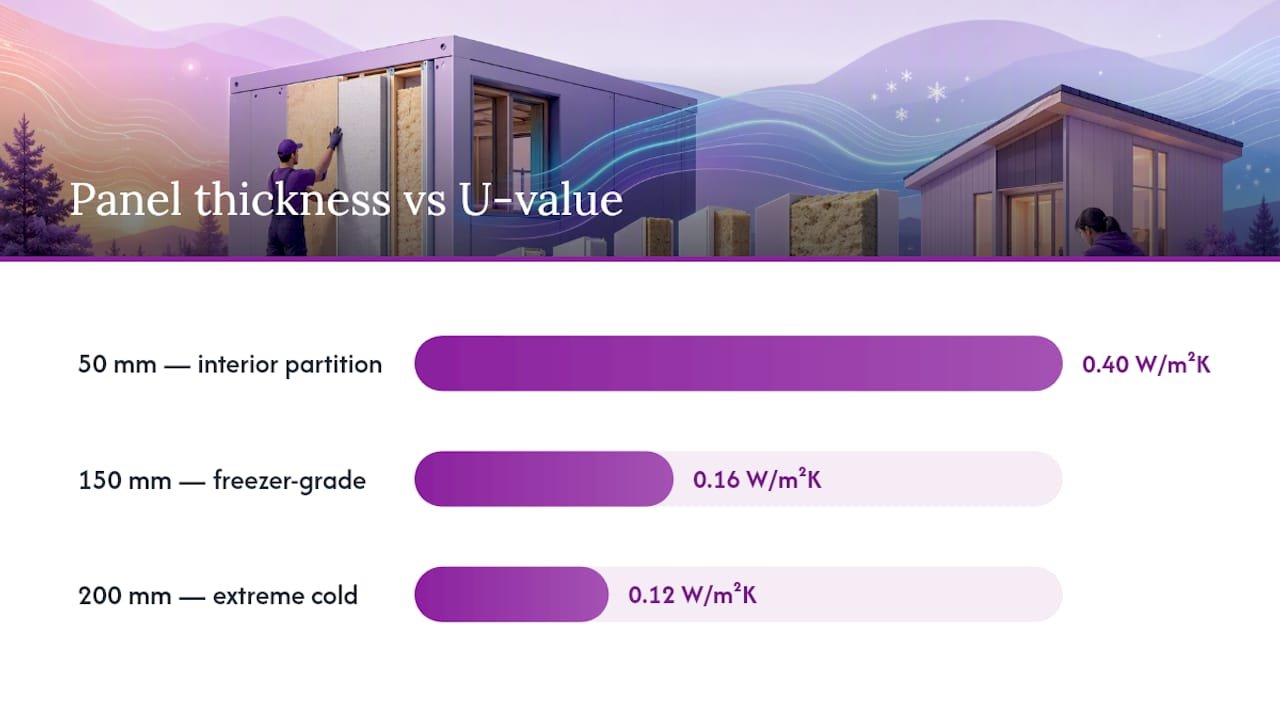
Thickness should map to your actual use case, not a round number that sounds safe. Rough guidance: 50 mm works for interior partitions, 75 to 100 mm covers most exterior walls in temperate climates, 100 to 120 mm suits cold rooms, and 150 mm is the floor for freezer-grade spaces. For a PU core, that translates roughly to U-values of 0.40 W/m²K at 50 mm down to 0.16 W/m²K at 150 mm, with 200 mm panels reaching around 0.12 W/m²K for extreme cold chambers.
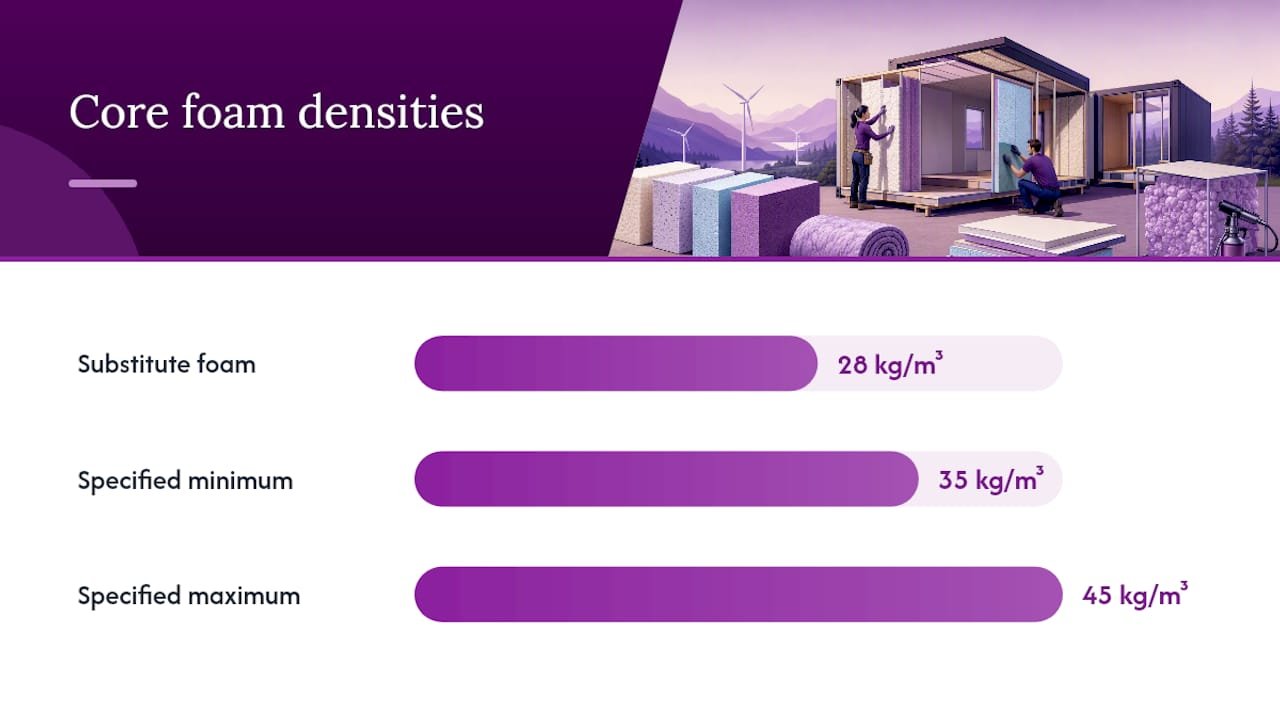
Core density is where corners get cut. Suppliers sometimes quote a lower-density foam to shave cost off the total, and a panel that looks identical on paper performs noticeably worse in the wall. For PU/PIR, insist on a minimum density of 35 to 45 kg/m³ rather than accepting whatever number shows up on the invoice.
Facing and coating depend on where the module sits. PPGI (zinc-coated steel) is the standard choice inland, PPGL or galvalume performs better in coastal or high-humidity sites, and PVDF coatings hold their color longest under intense UV exposure. Steel gauge should sit at a sensible 0.4 to 0.5 mm minimum for exterior walls and roofing that need to resist wind and snow loads. Ask for a mill test certificate (MTC) confirming the coating and gauge match what was quoted.
Joint systems affect airtightness more than most buyers expect. Tongue-and-groove joints with foam sealant are common and effective when installed carefully. Cam-lock systems speed up assembly and give a tighter mechanical pull. Built-in gaskets add another layer of air sealing at the joint line, which matters most in cold-room or freezer applications where every gap becomes a condensation risk.
What Should Buyers Check Before Ordering Container-Style Panels?
Work through these steps in order, and you’ll avoid comparing quotes that aren’t actually comparable.
- Define the end use and interior temperature target. A home office and a walk-in cooler have nothing in common thermally.
- Set your mandatory fire requirement first. If local code demands A1/A2 fire classification, that eliminates EPS and most conventional PU before you even look at pricing.
- Choose thickness and core density together, using the ranges above as your starting point, not your ceiling.
- Pick facing, coating, and joint type based on climate exposure and how airtight the assembly needs to be.
- Request certificate copies before paying a deposit, not after the panels arrive on site.
The documents worth asking for: a core density report tied to the actual batch, a fire classification certificate, an MTC for the steel facing, and ideally a third-party inspection report from a firm like SGS or BV. Total installed cost typically runs 20 to 35 percent above the panel price once you add connectors, flashings, and sealants, so build that into your budget before you compare quotes side by side.
Pro Tip: Ask every supplier for the same three documents in the same format. If one supplier can’t produce a density report or dodges the question, that’s your answer about their quality control, regardless of how attractive their price looks.
Homeowners tend to prioritize thermal comfort and fire safety in that order. Contractors weigh lead time and installed cost heavily. Entrepreneurs building retail or office modules usually care most about acoustic performance and finish quality, since customers notice both.
What Installation Mistakes Hurt Thermal Performance the Most?
Most performance complaints trace back to a handful of avoidable mistakes made before or during assembly, not to the core material itself.
The low-density substitution mentioned earlier is the most common one, and it’s also the hardest to catch after the fact. A panel with 28 kg/m³ foam instead of the specified 35 to 45 kg/m³ looks nearly identical but loses meaningful shear strength and thermal resistance. Request the density figure on the mill test certificate, and where the order size justifies it, ask for a third-party spot check.
Buyers also routinely underestimate accessory costs. Flashings, connectors, and sealants aren’t optional extras. They’re part of the system, and skipping a proper budget for them means either paying more later or living with gaps that leak air and moisture.
- Verify core density on paper before the panels ship, not after installation
- Budget 20 to 35 percent above panel price for accessories and labor
- Use gasketed joints and correct vapor control to prevent condensation at seams
- Handle and transport panels carefully. Bent facings or crushed edges cause delamination that no sealant fixes later
Pro Tip: Check every panel corner for facing separation before it goes into the wall. Delamination that starts at the edge during shipping only gets worse once the panel is load-bearing.
Thermal bridging shows up most often at window and door openings, where installers leave gaps rather than cutting panels to fit tightly. A well-sealed door assembly matters just as much as the wall panel around it, since a poorly sealed opening undoes a lot of the thermal work the panels are doing.
Why Integrated Panel Kits Reduce Specification Risk
Most of the mistakes covered above happen at the seams between decisions: a core from one supplier, facing from another, joint hardware bought separately, and nobody checking whether they actually match. Prefabmodularhome’s structural insulated sandwich panels bundle core, facing, and joint system into a single spec, which removes most of that mismatch risk before it happens.
That matters practically. SIP-style continuous envelopes can also shrink your HVAC sizing and simplify electrical rough-in work, since there’s no patchwork of insulation types to design around.
Before ordering any kit, confirm four things on the datasheet: core density, fire classification, the facing’s MTC, and the stated assembly time. If a kit’s paperwork answers all four clearly, you’ve already avoided the most common sources of costly rework.
Ready to Order? Here’s What to Prepare First
Before requesting quotes, nail down five things: intended use, floor area in square meters, target interior temperature, your mandatory fire rating, and any site constraints like access width or foundation type.
Once you have those answers, the documents to request are the same ones covered throughout this guide: a core density report, fire classification certificate, MTC for the steel facing, and, where the project size justifies it, a third-party inspection option. Skipping this step is how buyers end up comparing quotes that look similar on price but aren’t built to the same standard.
If you’re planning a home office, rental unit, or backyard studio, the structural insulated sandwich panels product page has the technical datasheets you’ll need to start that comparison. For cold-sensitive builds or tight floor plans, the PU panel guide for backyard builds walks through how thinner walls still hit strong thermal targets. And if you’re mapping out a larger addition, the modular home extensions planning guide is the right starting point for laying out area, site constraints, and fire requirements before you request a single quote.
Where Container Insulation Choices Land in Practice
Here’s the part conventional wisdom skips: most buyers lose money not by picking the wrong core material, but by treating the certificate request as optional paperwork instead of the actual product. A panel’s thermal conductivity number on a spec sheet means nothing if the batch that ships doesn’t match it, and the only way to know is a density report and a fire classification tied to that specific order.
The other misconception worth challenging is that thicker always means better. A 150 mm panel with under-spec density can underperform a properly made 100 mm panel. Thickness compensates for weak core quality on paper, not in practice. That’s why the checklist in this guide leads with density and certification before it ever gets to thickness math.
Where I’d push back hardest on typical buying advice: don’t treat rockwool, PU/PIR, and EPS as a simple price ladder where you just pick what you can afford. They solve different problems. Buying rockwool for a project that never needed an A1 fire rating wastes money on weight and thickness you didn’t need. Buying EPS for a freezer application is a performance failure waiting to happen, no matter how good the price looked on the quote.
— Kian
Sources
For a deeper technical breakdown of core materials and their properties, the sandwich panel buying guide and SIP resource guide both cover thermal conductivity and R-value data in more depth. For fire and structural comparisons across core types, see the core materials and applications guide. Whatever you read, keep the same document request ready: density report, fire class, MTC, and third-party inspection where the order size warrants it.
- Insulated Sandwich Panel Buying Guide 2026: EPS vs PU vs Rockwool Core | CAMELSTEEL
- What are SIPs? | PGS Consulting LLC
- Sandwich Panel Structure: Core Materials & Applications | Raxpanel