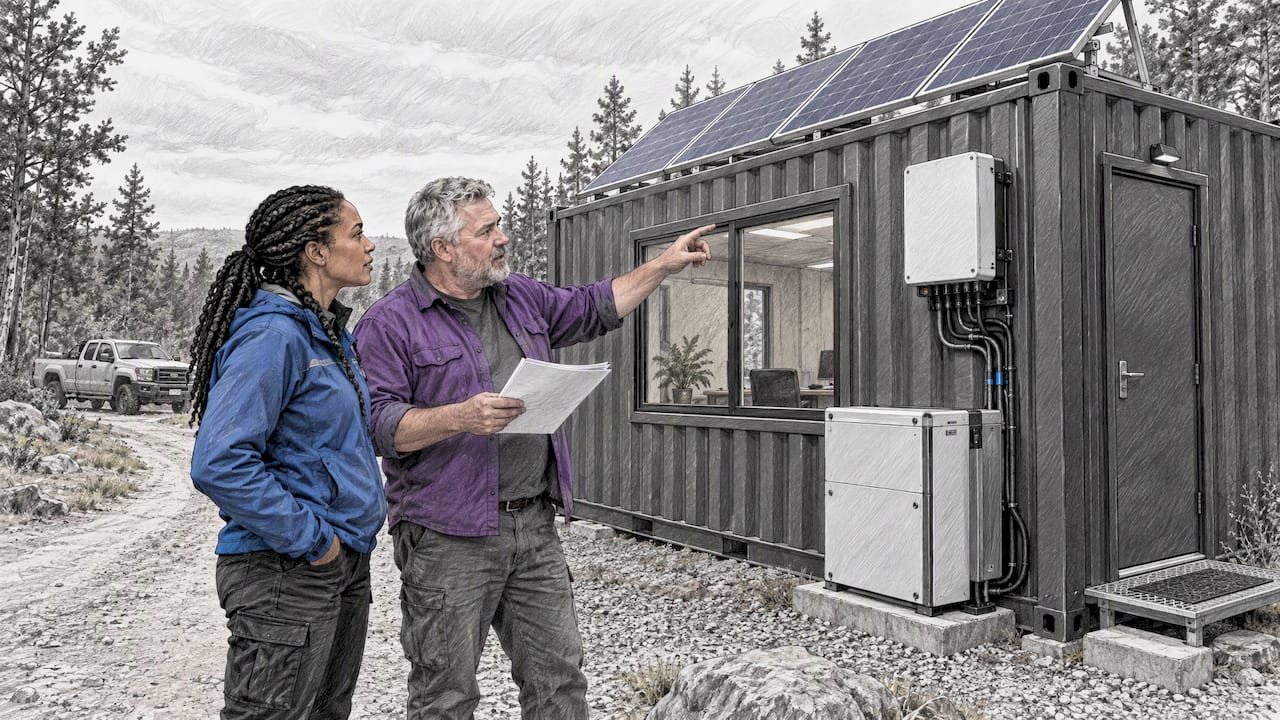
Yes, a properly specified solar-powered container office, meaning a steel shell paired with a sized PV array, an inverter, batteries, and a sealed insulated assembly, works well as an off-grid workspace for remote job sites, rural businesses, and standalone studios. The core package includes rooftop or folding solar panels, an inverter, battery storage, insulation, and climate control. Before you sign anything, confirm the vendor has sized the system from your actual hourly loads and specified a real moisture-control plan, not just a panel wattage number.
TL;DR:
- Proper sizing of the PV system depends on an accurate hourly load profile rather than panel wattage ratings, which are a common cause of underperformance.
- Insulation, vapor control, and sealing are critical to prevent condensation, with factory-built sandwich panels reducing the risk of moisture leaks and thermal bridging.
- Logistics and site access are major cost drivers for remote locations, requiring early planning for delivery, crane access, and spare parts procurement.
- Incorporating a backup generator alongside solar and batteries enhances reliability, especially in low-sun or cloudy conditions, but adds system complexity.
- Vendors should provide detailed load worksheets, wiring diagrams, moisture-control specs, and clear responsibilities for site prep and maintenance before finalizing the quote.
Table of Contents
- What Goes Into a Solar-Powered Off-Grid Container Office
- How to Size Your Panels, Inverter, and Batteries Correctly
- Insulation, Vapor Control, and HVAC in a Steel Box
- Planning Delivery, Access, and Serviceability for Remote Sites
- Budgeting and Funding: What Drives the Price
- Buyer Checklist: What to Require in Every Quote
- Why Factory-Built Insulated Panels Reduce Procurement Risk
- Managing and Optimizing Energy Once the System Is Running
- Maintenance and Troubleshooting for Off-Grid Container Systems
- Adding Wind or a Generator Alongside Solar
- Keeping a Remote Container Office Secure
- Staying Connected at a Remote or Off-Grid Site
- Three Priorities I’d Set Before Signing a Container Office Quote
- How Prefab Modular Homes Supports Your Container Office Plans
- FAQ
- Sources
What Goes Into a Solar-Powered Off-Grid Container Office
A workable unit has five layers that all have to agree with each other: the shell, the power generation, the storage, the climate system, and the building envelope. Mismatch any one of these and you get a hot, humid, or dead-battery office within a season.
Most buyers start with a 20ft or 40ft steel container, either a field conversion or a factory-fit unit. PV arrays go on fixed rooftop racks or folding mounts that reduce shipping volume and speed up on-site deployment. Container-roof PV systems built for 20 to 40ft containers are available in both formats, and manufacturer specs show daily output in the range typically expected for 9.8 to 19.6 kWp systems, depending on model and sun exposure.
A typical 20ft example used across vendor spec sheets pairs a smaller rooftop array with a modest inverter and an optional battery bank, plus a small mini-split for comfort. That is a baseline to compare against, not a target.
- Shell: 20ft units suit a single office; 40ft units suit a team or added storage.
- Power: AC-coupled inverters integrate easily with existing gear; DC-coupled hybrid inverters are usually more efficient for new off-grid builds.
- Batteries: lithium chemistries dominate new installs for cycle life and weight.
- Comfort: mini-split heat pumps plus mechanical ventilation handle most climates.
How to Size Your Panels, Inverter, and Batteries Correctly
Guessing from a panel’s wattage rating is the single most common reason off-grid container offices underperform. The fix is an hourly load inventory built before you ever talk to a vendor.
- List every device that will run in the office: wattage, hours of use per day, and start-up surge (a mini-split or compressor can surge to several times its running wattage).
- Convert to daily kilowatt-hours by multiplying each device’s wattage by its hours of use, then summing the totals.
- Identify your peak and surge wattage separately, since this determines inverter sizing, not your daily energy total.
- Choose a battery autonomy target in hours, factoring in cloudy-day reserves and seasonal HVAC swings, then size the bank against your depth-of-discharge limit.
- Model or verify with an engineer once you have real numbers, rather than relying on a vendor’s rule-of-thumb sizing.
Practitioners who size from hourly profiles rather than simple heuristics avoid the two most common mistakes: an inverter that trips on compressor startup, and a battery bank that runs out by late afternoon in winter.
Pro Tip: Ask any vendor for a wiring diagram and a load worksheet before you accept a quoted battery size; a number with no worksheet behind it is a guess.
Insulation, Vapor Control, and HVAC in a Steel Box
A steel container with a thick layer of insulation and nothing else will still sweat. Condensation forms wherever warm, moist interior air reaches the cold steel skin, and over time that moisture corrodes the shell and rots any wood trim inside. Air-sealing and a deliberate vapor strategy matter as much as R-value.
Regional vapor-barrier guidance for container conversions compares three common approaches: 6-mil polyethylene sheeting on the warm interior side (a solid default in heating-dominated climates), smart variable-permeability retarders (better where humidity swings both directions seasonally), and closed-cell spray foam, which combines insulation and an air/vapor barrier in one step but costs more and needs careful application around penetrations.
- 6-mil poly: low cost, works well in consistently cold climates, demands careful seam taping.
- Smart retarders: adapt their permeability with humidity, suited to mixed or humid climates.
- Closed-cell spray foam: combines insulation and vapor control, higher material cost.
A container office commonly has 20 to 30 wall penetrations for outlets, lighting, and HVAC lines, and each one is a potential vapor-barrier failure point unless it uses a sealed flange or a pre-fabricated panel penetration. Factory-built insulated sandwich panels cut this risk substantially because the vapor barrier and insulation are integrated in the panel itself rather than assembled on-site piece by piece, which also reduces thermal bridging at the frame. For HVAC, a correctly sized mini-split heat pump handles most climates, but it needs to be paired with mechanical ventilation and, in humid regions, a dedicated dehumidification cycle to keep the sealed box from building up moisture.
Planning Delivery, Access, and Serviceability for Remote Sites
Remote-site logistics routinely add more cost and delay than the build itself. Crane access, a prepared pad or foundation, and the width of the delivery route all need confirmation before a unit ships, because a container that cannot reach its pad becomes an expensive problem on-site rather than a planning note on paper.
A documented Galena, Alaska community-scale solar and battery project illustrates what remote logistics actually cost: barge-season shipping windows, limited local labor capacity, and high freight costs all shaped the project’s delivery timeline and ongoing maintenance planning. Any off-grid container buyer in a remote location should expect similar constraints.
- Confirm crane and transport access to the exact pad location before ordering.
- Order long-lead equipment early and plan for a spares kit, since a failed part can mean weeks of downtime in a remote location.
- Verify who commissions the system and who handles future battery replacement, since not every region has a local installer familiar with your equipment.
- Keep a small generator as backup even in a solar-first design, for extended low-sun stretches or equipment failure.
Budgeting and Funding: What Drives the Price
Four things drive most of the cost spread between a basic off-grid container office and a well-specified one: the size of the PV and battery system, how much of the shell needs structural conversion, the HVAC specification, and site work.
Remote delivery can add a real premium on top of the base build. Barging, as seen in the Galena project, or air freight for especially isolated sites, can push logistics costs well above what a comparable urban delivery would cost, so get a firm delivery quote before finalizing a budget.
Some resilience-focused funding exists for battery and inverter installations, particularly through the U.S. Department of Energy’s Grid Deployment Office battery installation guidance, which provides standardized engineering designs and survey tools for resiliency grants under federal infrastructure provisions. These programs typically support design and procurement coordination for qualifying communities and tribes, though they may exclude certain generation or charging design costs from the eligible scope, so confirm applicability directly rather than assuming eligibility.
- PV and battery sizing is usually the single largest line item.
- Conversion level (field conversion versus factory-built) shifts both cost and risk.
- Site work and delivery can rival the equipment cost on remote sites.
- Contingency of extra budget room covers freight surprises and site-prep changes.
Buyer Checklist: What to Require in Every Quote
Treat the quote itself as a specification document, not a sales sheet. If a vendor cannot produce the items below, that is useful information on its own.
- Require an hourly load worksheet showing how the PV, inverter, and battery sizes were derived.
- Request full equipment spec sheets, including inverter model and battery chemistry and cycle life.
- Ask for a wiring diagram and a commissioning plan, not just a parts list.
- Get the moisture-control specification in writing, naming the vapor-barrier approach and penetration-sealing method.
- Confirm delivery method and who is responsible for site prep, crane access, and the foundation or pad.
- Check warranty terms and the service plan, including who handles battery replacement later.
- Ask for a spare-parts list and a maintenance schedule tailored to your specific equipment.
Pro Tip: A vendor who hands you a load worksheet unprompted is usually the one who sized the system correctly in the first place.
Why Factory-Built Insulated Panels Reduce Procurement Risk
Field-built insulation and vapor barriers depend on whoever is holding the caulk gun that day, and a missed seam or a poorly sealed penetration can undo months of planning. Insulated sandwich panels are manufactured with the structural layer and the insulation integrated in a single factory step, which removes most of the on-site judgment calls that cause vapor-barrier failures.
- Factory sealing reduces the chance of the 20 to 30 penetration points in a typical office becoming long-term leak paths.
- Integrated panels cut thermal bridging at the frame compared with site-applied insulation layered over steel ribs.
- Pre-fabricated assembly shortens on-site installation time compared with building an insulation and vapor system piece by piece.
This matters most for remote builds, where a correction trip for a failed seal is expensive and slow to schedule.
Managing and Optimizing Energy Once the System Is Running
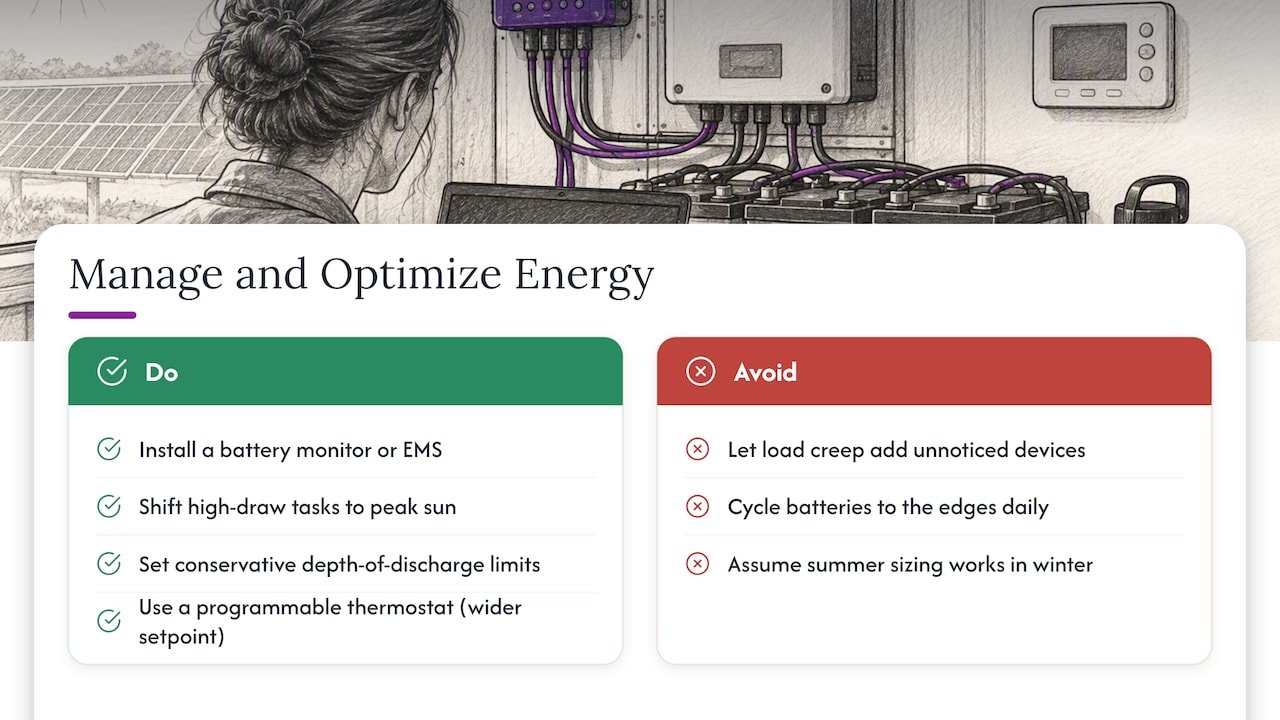
Sizing the system correctly gets you most of the way there, but day-to-day energy management determines whether that sizing holds up through the seasons. Off-grid systems fail less often from undersized hardware than from unmanaged load creep, where a space heater or a second monitor quietly pushes daily consumption past what the battery bank was built to cover.
A battery monitor or energy management system that tracks state of charge in real time lets you see a problem coming instead of discovering it when the lights go out. Pair that with load-shifting habits: run higher-draw tasks like charging equipment or running tools during peak sun hours, and shift anything flexible away from early morning or evening when the battery is working from stored charge alone.
Setting conservative depth-of-discharge limits extends battery life, and most lithium systems perform best when kept within a moderate charge window rather than cycled to the edges every day. A programmable thermostat on the mini-split, set a few degrees wider than you would run on grid power, reduces one of the largest variable loads in the building without much comfort trade-off.
Seasonal adjustment matters too. Winter HVAC loads and shorter daylight hours change the math from what you had in summer, so revisit your load assumptions twice a year rather than assuming the original sizing holds permanently. A system that was comfortably oversized in July can run tight in December if nothing is adjusted.
Maintenance and Troubleshooting for Off-Grid Container Systems
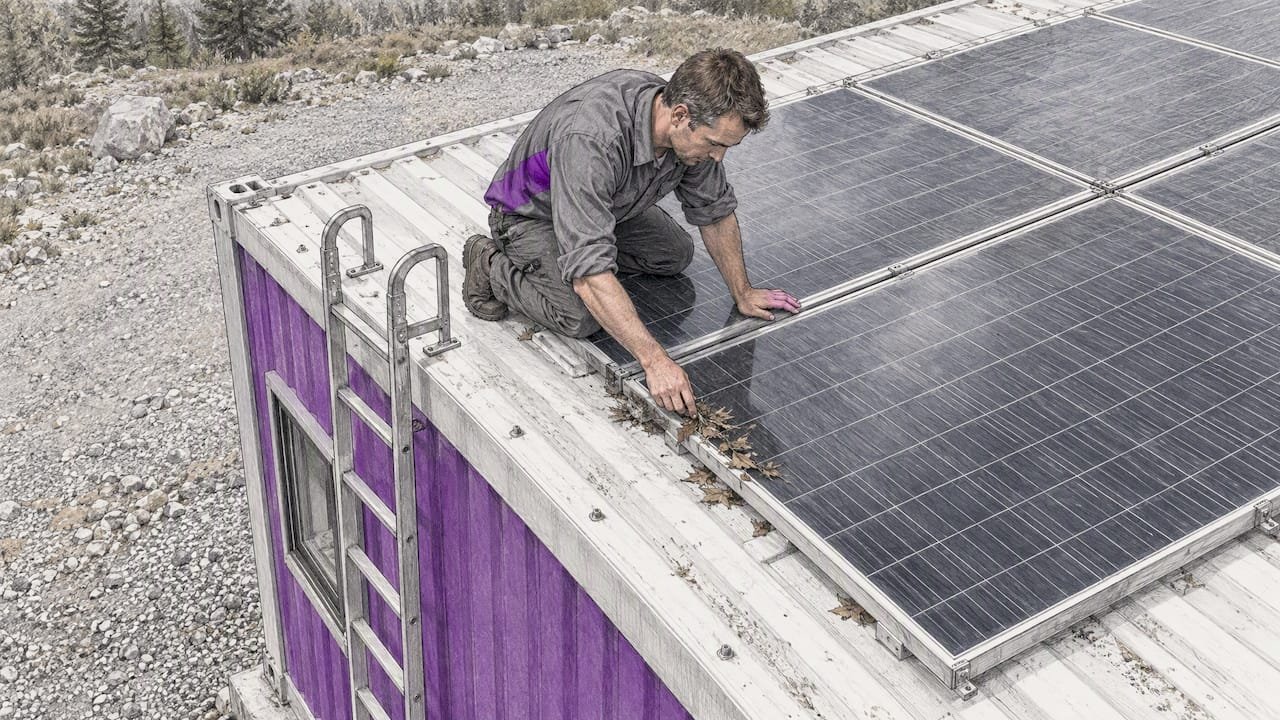
Off-grid systems need less maintenance than most buyers expect, but the maintenance they do need is specific and easy to neglect from a distance. Panels should be checked periodically for dust, debris, or snow accumulation, since even a partial shading loss on a rooftop array can disproportionately cut output depending on wiring configuration.
Batteries are the component most likely to need attention. Lithium battery banks generally need little beyond keeping terminals clean and verifying the battery management system is reporting correctly, but a sudden drop in usable capacity is usually the first sign of a failing cell group rather than something to ignore. Inverters occasionally trip on surge loads, and a pattern of repeated trips on the same appliance usually points back to an undersized surge rating rather than a faulty unit.
Keep a basic troubleshooting routine: check state of charge and recent generation history first, inspect physical connections second, and only escalate to a technician once those two steps rule out the obvious. For remote sites, this is where a spare-parts kit and a documented wiring diagram pay for themselves, since a technician visit can take days to arrange.
Routine inspection of the building envelope matters just as much as the electrical system. A yearly check of seals around HVAC penetrations and any visible condensation inside the wall cavity catches moisture problems early, before they become corrosion or mold issues that are far more expensive to fix than a resealed penetration.
Adding Wind or a Generator Alongside Solar
Solar alone covers most off-grid container offices, but it is not always the complete answer, particularly in regions with long stretches of low sun or heavy winter cloud cover. A small wind turbine can complement solar in sites with consistent wind resources, since wind and solar generation often peak at different times of day and year, smoothing out the combined output somewhat.
A backup generator remains a sensible addition even in a solar-first design. Hybrid systems that default to solar and batteries, with a generator as a reserve, let you size the battery bank for typical conditions rather than for the worst-case week of the year, which keeps the upfront battery cost more reasonable.
The practical trade-off is complexity. Each additional generation source needs to be integrated through the inverter or a separate charge controller, and every added component is another thing that can fail in a remote location. For most container offices, a generator as backup is the simpler and more common choice, while wind makes sense specifically where the site has a known, consistent wind resource worth the added hardware and wiring.
Whatever combination you choose, the inverter and battery sizing from your hourly load profile should still be the anchor. Additional generation sources extend your autonomy and reduce generator run time, but they do not replace the need for a correctly sized core system.
Keeping a Remote Container Office Secure
A standalone container office in a remote location is a visible, often unattended target, and security planning deserves the same attention as the power system. The steel shell itself offers a baseline of physical security that a stick-built structure does not, but standard doors and windows are still the weak points.
Upgrading to commercial-grade locks and door hardware, plus steel security bars or shutters on windows, addresses the most common forced-entry points. Motion-activated lighting powered from the same battery system adds a low-cost deterrent that does not meaningfully affect your energy budget, since LED fixtures draw little power and only run when triggered.
For sites without regular human presence, a battery-powered or low-power cellular security camera system is worth the investment, particularly one that can send alerts over whatever connectivity the site has. Tying security monitoring into the same communication system you use for connectivity, rather than running a separate system, keeps both maintenance and power draw simpler.
Spare equipment and battery banks are also theft targets in remote areas, so secure storage for anything not permanently installed matters as much as securing the building itself.
Staying Connected at a Remote or Off-Grid Site
Power is only useful if the office can actually function as a workspace, and connectivity is often the harder problem at a remote site. Cellular signal strength varies enormously by location, so checking actual coverage at the exact site, not just the general area, should happen before you finalize plans.
Where cellular coverage is weak or absent, satellite internet systems have become a practical option for remote offices, offering workable bandwidth for video calls and standard office tasks without requiring a wired connection. These systems do add their own power draw, which should be included in your hourly load worksheet rather than treated as an afterthought.
A cellular signal booster can meaningfully improve a weak but present signal, which is often cheaper than moving straight to satellite service if the site has any coverage at all. For sites with no connectivity at all, a combination of satellite internet and a battery-backed router setup, sized into the main power system, is the most reliable path to a functional remote workspace.
Three Priorities I’d Set Before Signing a Container Office Quote
If I were buying one off-grid container office for a remote site, I would not start with the panel wattage, and I would not let a vendor start there either. Size everything from an hourly load profile first, because a surge-current mismatch or an undersized battery bank shows up the first cold week, not on the spec sheet.
Second, I would put moisture control and commissioning in writing, as specific line items, not a vague “fully insulated” claim. Third, I would plan for maintenance access and battery replacement before delivery, not after the first failure, since remote service calls are the slowest and most expensive part of owning one of these.
— Kian
How Prefab Modular Homes Supports Your Container Office Plans
We build toward the same priorities covered above: correct sizing, sealed moisture control, and fast, low-risk installation. Our structural insulated sandwich panels integrate insulation and vapor control into one factory-sealed assembly, which removes much of the on-site guesswork that causes condensation and corrosion problems in field-built conversions.
Our container office line is built around that same sandwich-panel approach, and our broader product catalog covers DIY kit rooms, container homes, and container shops for readers weighing different workspace formats. If you are planning a remote or off-grid build, we recommend starting with an hourly load worksheet and a site-prep checklist before requesting a quote, since that is the information that actually determines what system size and panel configuration you need.
- We supply factory-sealed insulated panels that reduce on-site vapor-barrier errors.
- Our container office kits are designed for assembly without specialized tools.
- Our planning guides help you prepare a site-prep checklist before ordering.
Reach out through our container office product page to request specifications and discuss your site requirements.
FAQ
How much solar power does a 20ft container office need?
It depends entirely on your hourly load profile rather than a fixed number, since a unit with just lighting and a laptop needs far less than one running a mini-split and tools. Vendor examples for small 20ft offices commonly pair a rooftop array in the 1 to 2 kW range with a few kW of inverter capacity, but you should confirm your own sizing against an actual load worksheet rather than copying a spec sheet.
What is the best vapor barrier for a container conversion?
The best choice depends on climate: 6-mil polyethylene sheeting on the interior side works well in consistently cold, heating-dominated climates, while smart variable-permeability retarders perform better where humidity swings seasonally in both directions. Regional technical guidance also notes that closed-cell spray foam can combine insulation and vapor control in one step, at a higher material cost.
Can an off-grid container office run entirely on solar?
Yes, for many use cases, provided the PV array, inverter, and battery bank are sized from real hourly loads rather than estimated from panel wattage alone. Many owners still keep a small backup generator for extended low-sun periods, which lets the battery bank be sized for typical conditions instead of worst-case weather.
How do I reduce condensation risk inside a steel container office?
Condensation forms where warm, moist air meets the cold steel skin, so the fix combines air-sealing, a deliberate vapor-barrier strategy, and mechanical ventilation rather than insulation alone. Factory-built insulated sandwich panels integrate the vapor barrier into the panel itself, which removes many of the site-assembly errors that cause leaks at penetration points.
Are there funding programs for off-grid battery systems?
Some resilience-focused funding exists through programs like the U.S. Department of Energy’s Grid Deployment Office battery installation guidance, which supports standardized engineering designs for qualifying communities and tribes. Eligibility and covered costs vary by program, so confirm directly with the administering agency rather than assuming your project qualifies.
Sources
- Vapour barrier installation shipping container Ontario | Van Blanc
- Container office roof PV systems (Powerlink Energy)
- Galena community-scale solar PV and battery project (DOE)