A basic 20-foot container office usually costs in the mid tens of thousands turnkey. A mid-spec build falls in a higher range, and premium setups with bathrooms, glazing, or multiple units typically cost significantly more. Renting instead typically costs a few hundred to close to a thousand dollars per month depending on size and features. Buying usually breaks even against renting somewhere between 18 and 36 months, so the right call depends almost entirely on how long you need the space.
TL;DR:
- Structural modifications such as windows, doors, and large openings can significantly increase costs, sometimes adding tens of thousands of dollars.
- Insulation, HVAC, electrical, plumbing, permits, and delivery can collectively raise a mid-range 20-foot container office cost to between $40,000 and $75,000.
- Site readiness expenses, including foundation, utility hookups, and crane placement, often add $5,000 to $15,000 to the total project cost.
- Renting is usually more economical for stays shorter than 18 months, with a break-even point between 18 and 36 months for buying versus renting.
- Using structural insulated sandwich panels offers a faster, more energy-efficient alternative to retrofitting container shells, especially at mid and high budgets.
Table of Contents
- What Drives Container Office Cost Line by Line?
- What Do Basic, Mid-Range, and Premium Builds Actually Cost?
- Should You Rent or Buy a Container Office?
- What Hidden Costs Catch Container Office Buyers Off Guard?
- How Much Does Insulation Add to Container Office Costs?
- How Long Does a Container Office Project Take?
- When Does a Container Office Beat a SIP-Panel Build?
- A Faster, Better-Insulated Alternative to Container Retrofits
- Sources
- FAQ
What Drives Container Office Cost Line by Line?
The container itself is rarely the expensive part. A used shipping container might cost a few thousand dollars, while a one-trip or new unit costs somewhat more. A 40-foot box costs more upfront but usually delivers a lower cost per square foot once you factor in modifications, since you’re spreading fixed labor and permit costs over double the floor space.
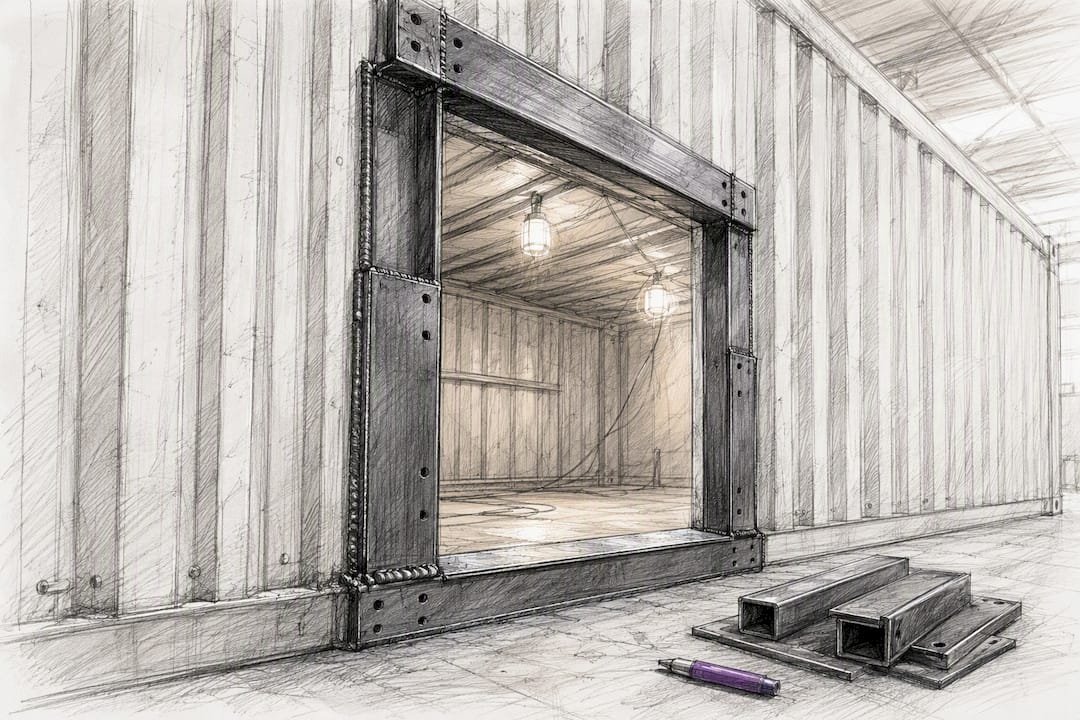
Where budgets actually blow up is in structural modification. Cutting a window or door opening into corrugated steel means adding steel reinforcement around that cut, because the container’s strength comes from its continuous skin. Joining two units, stacking a second story, or cutting a large glass storefront opening turns a simple conversion into an engineering project, with steel framing and welding work that can add tens of thousands of dollars for multi-unit or high-glazing builds. If you’re planning a private office carved out of an open shell, the same logic that applies to creating a private office without losing an open feel in conventional buildings applies here: every wall or opening you add has a structural cost attached.

Insulation and mechanical systems make up the next big chunk. Sourced pricing tables put finishes and insulation at roughly $3,000 to $15,000, HVAC systems at $2,000 to $12,000, and permits at $500 to $6,500, which together push a mid-spec build’s midpoint to somewhere around $40,000 to $75,000.
A realistic line-item breakdown looks something like this:
- Container shell (used, 20ft): $2,000–$4,000
- Container shell (one-trip/new, 20ft): $4,000–$6,000
- Structural modifications (windows, doors, framing): $2,000–$15,000+
- Insulation and interior finishes: $3,000–$15,000
- HVAC (mini-split or packaged unit): $2,000–$12,000
- Electrical (panel, wiring, lighting): $1,500–$8,000
- Plumbing (if bathroom/kitchenette included): $2,000–$10,000
- Delivery and crane placement: $500–$5,000
- Permits and engineering review: $500–$6,500
Pro Tip: Always ask vendors for an itemized quote that separates the container shell, modifications, delivery, craning, foundation work, and permit fees. A lump-sum number is where hidden costs hide, and breaking out MEP hookup from the shell price is the only way to compare two quotes fairly.
Build in a contingency of roughly 10 to 15 percent on top of your line-item total. Container conversions have a way of surfacing surprises once you cut into the steel, and that buffer keeps a mid-project discovery from becoming a mid-project crisis.
What Do Basic, Mid-Range, and Premium Builds Actually Cost?
Numbers mean more when they’re attached to a real scope. Here’s what each tier typically buys you.
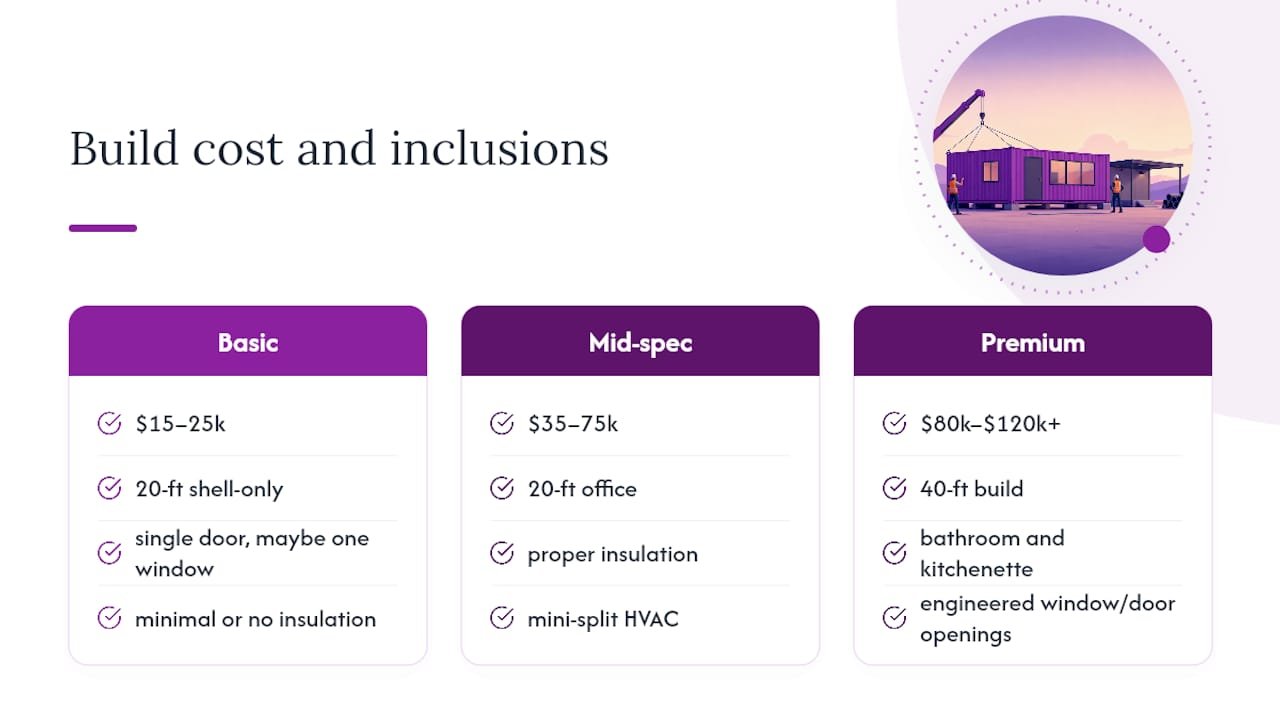
Basic 20-foot shell-only build: Expect around $15,000 to $25,000. This usually covers a used or lightly modified container, a single door and maybe one window, minimal or no insulation, and no plumbing. It’s a storage-adjacent office at best, not something you’d put a client in during summer or winter without supplemental heating and cooling.
Mid-spec 20-foot office: Budget $35,000 to $75,000. This tier typically includes proper insulation, a mini-split HVAC system, a full electrical package with lighting and outlets, basic interior finishes like vinyl flooring and drywall-style paneling, and a utility hookup to power and sometimes water. This is the range most small businesses land in for a functional, comfortable workspace.
Premium 40-foot build: Costs climb past $80,000 and can reach $120,000 or more once you add a bathroom, a kitchenette, engineered window or door openings, and higher-end finishes like tile or custom cabinetry. Multi-unit or storefront-style projects with large glazing sections push even higher, since reinforcement and steel framing drive cost more than finishes do at this level.
Per-square-foot guidance is tricky because container conversions don’t scale linearly the way stick-built additions do, but prices vary substantially depending on finish quality and design complexity. Regional labor rates and delivery distance can swing any of these totals by 10% to 25% in either direction, so a quote from a rural contractor and one from a dense metro area won’t be apples to apples.
Should You Rent or Buy a Container Office?
Renting keeps you flexible, and that flexibility has a price tag: often a few hundred to nearly a thousand dollars per month depending on size, features, and distance. A bare 20-foot unit with minimal buildout sits at the low end; a fully finished 40-foot office with HVAC and electrical sits at the high end.
The math for deciding which route makes sense breaks down like this:
- Estimate your holding period. If you need the space for under a year, renting almost always wins on cash flow.
- Run the break-even. If a comparable turnkey unit costs $20,000 to buy and rent runs $800 a month, you break even at 25 months, right in the middle of the typical 18 to 36 month range reported across the industry.
- Weigh resale value. Owned units retain some resale value; rented units don’t build any equity at all.
Renting fits best when your site or permit timeline is uncertain or the project is genuinely temporary. Buying makes more sense once you’re past that 18 to 36 month horizon or plan to relocate the unit to future job sites.
What Hidden Costs Catch Container Office Buyers Off Guard?
The container price is the easy number. The expensive surprises live in the ground underneath it and the utility lines running to it. Site-readiness work commonly adds $5,000 to $15,000 that buyers forget to price in until the delivery truck is already scheduled.
- Foundation: a gravel pad might run $500 to $2,000, while concrete piers or an engineered slab can reach $5,000 to $15,000 for larger units.
- Utility hookups: electrical trenching, water lines, and sewer or septic connections add $1,000 to $10,000 depending on how far the container sits from existing service.
- Crane placement: tight or remote sites can push delivery and craning fees toward the higher end of that $500 to $5,000 range.
- Permits and engineering review: plan review alone can take weeks, and fees run $500 to $6,500 depending on jurisdiction.
Pro Tip: Get a site survey before you order the container, not after. Distance from the nearest power pole or water main is the single biggest hidden-cost lever, and it’s the one most buyers discover too late. Our construction site planning guide walks through exactly what to check before delivery day.
How Much Does Insulation Add to Container Office Costs?
An uninsulated steel box sweats. Condensation forms on the interior walls whenever warm, moist air meets cold steel, and left unaddressed it leads to rust and mold inside the very walls you’re paying to finish. That’s why insulation isn’t a line item you can skip to save money.
- Spray foam: best air-seal and thermal performance, typically the priciest per square foot.
- Batt insulation: cheaper upfront, more prone to gaps and thermal bridging at the steel ribs.
- Structural insulated sandwich panels: integrate structure and insulation in one step, which tends to cut both material waste and labor time compared to retrofitting insulation into an existing shell.
HVAC sizing follows the same logic. A well-insulated 20-foot office can run on a modest mini-split, while a poorly insulated one needs an oversized unit working overtime, and that shows up every month on the power bill.
How Long Does a Container Office Project Take?
Plan on four phases: sourcing and procurement (2 to 6 weeks), modification and fabrication (3 to 8 weeks), site prep and delivery (1 to 3 weeks), and permitting plus final inspection, which often runs parallel to the other phases but can add its own delay if approvals stall.
- Procurement: ordering the container and locking in a modification vendor.
- Modification: cutting openings, welding reinforcement, installing insulation and MEP rough-in.
- Site work and delivery: foundation prep, crane placement, utility connection.
- Permits and inspection: plan review, final walkthrough, occupancy sign-off.
Permit delays are the most common schedule killer, so build in a two to four week buffer on top of your estimated timeline. On the money side, keep 10% to 20% of your total budget as contingency, weighted more heavily toward site work and permitting than toward finishes, since that’s where estimates run short most often.
When Does a Container Office Beat a SIP-Panel Build?
Containers win when mobility matters. A steel box can be craned onto a truck and relocated to a new job site, which SIP-panel structures generally aren’t built to do. But once insulation, condensation control, and long-term energy bills enter the picture, structural insulated panels tend to deliver better thermal performance with less retrofit risk. For a temporary site office, buy the container. For a backyard studio or a permanent client-facing space, a SIP-panel build is usually the lower-risk bet.
— Kian
A Faster, Better-Insulated Alternative to Container Retrofits
If the insulation math in this guide gave you pause, that’s a common problem builders face. Instead of retrofitting a steel shell that fights condensation and thermal bridging, Structural Insulated Sandwich Panels combine structure and insulation into a single assembly step, which means fewer labor hours spent chasing thermal leaks and lower energy bills once the space is finished.
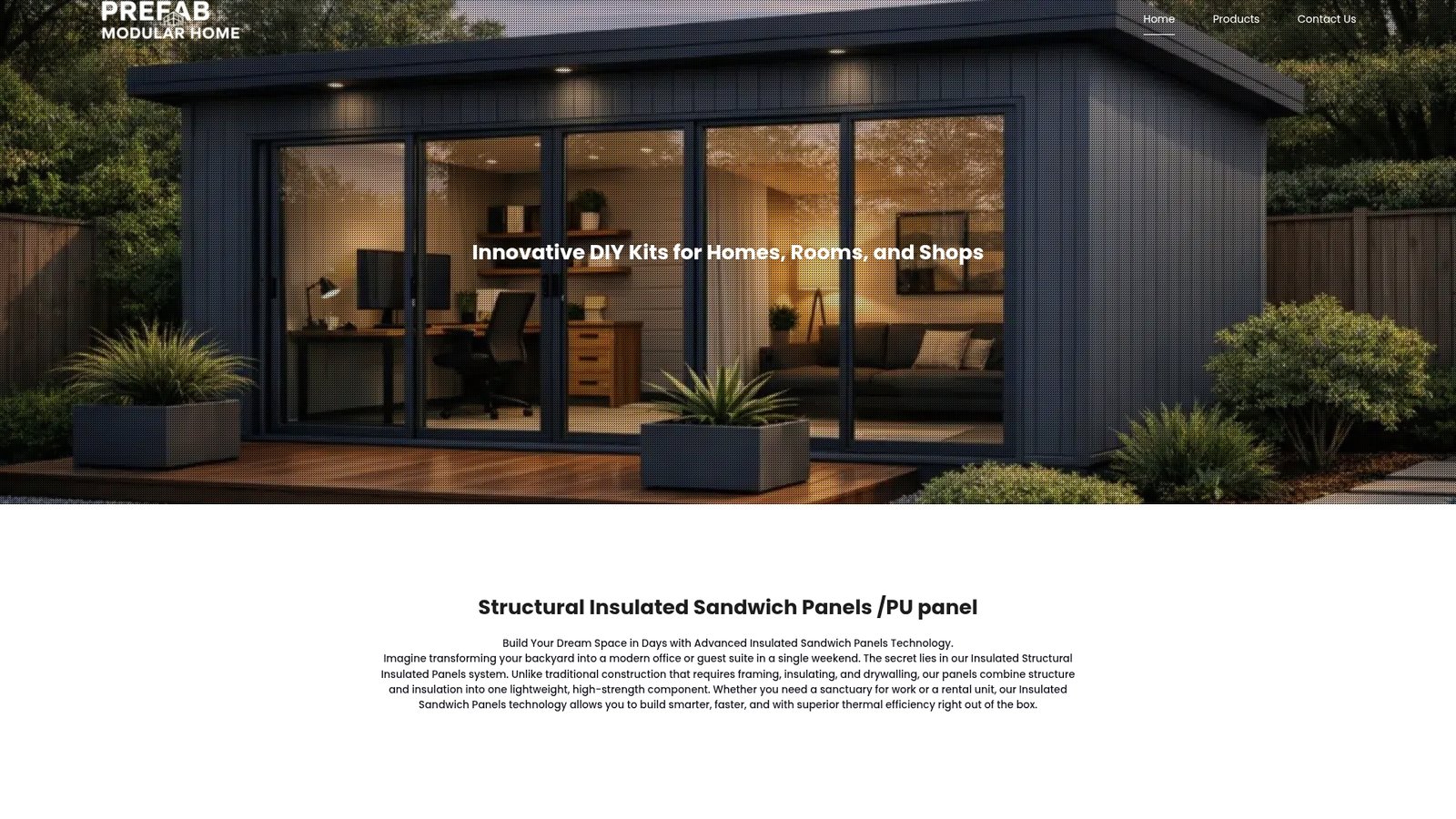
These kits are designed for assembly in days, not weeks, and may require minimal construction skills to put together. That matters most for the mid and premium budgets covered above, where HVAC and finish costs climb fastest, since better insulation shrinks the equipment size and the monthly operating cost right from the start. Browse our Structural Insulated Sandwich Panels or explore full modular home extension options, then request a quote to see how a SIP-panel build compares to the container budget you just built.
Sources
- Cost Breakdown for Container Offices – Container Pricer
- Shipping Container Offices | Buy or Rent, Deployed in Weeks
- Shipping Container Office Cost Guide 2026 – LatestCost
FAQ
How Much Does It Cost to Build a Container Office?
A basic 20-foot container office generally costs in the mid tens of thousands, a mid-spec build falls in a higher range, and premium builds with bathrooms or engineered openings usually cost significantly more.
How Much Does a 40-Foot Container Office Cost?
A 40-foot turnkey container office typically starts in the mid tens of thousands and can cost substantially more once insulation, HVAC, electrical, and finishes are added, with premium multi-room layouts significantly increasing the total.
How Much Is a Shipping Container Office to Rent?
Monthly rental rates typically range from several hundred dollars to close to a thousand, depending on unit size, buildout level, and delivery distance, with many quotes near the mid hundreds to low eight hundreds for a finished 20-foot unit.
What Are the Downsides of Container Offices?
The main downsides are high customization costs for structural openings, condensation risk without proper insulation, engineering challenges when joining multiple units, and permitting delays that can stall a project for weeks. SIP-panel alternatives address the insulation and condensation risk more directly since structure and insulation are built as one layer.
Is It Cheaper to Rent or Buy a Container Office?
Renting is cheaper for projects under roughly 18 months; buying typically breaks even against rental costs somewhere between 18 and 36 months depending on unit specs and local delivery fees.