
Yes, in many cases ADU rental income can be used to qualify for a mortgage and generate real cash flow, but lenders cap how much counts and require documentation. Expect a qualifying limit on total income generally capped at a percentage set by FHA guidance, mandatory lease or appraisal comparables, and no path to approval for an unpermitted unit. Start by estimating conservative local rent, confirming zoning and permit status, and lining up comparable rentals or a draft lease before you apply.
TL;DR:
- FHA allows lenders to count up to 75% of projected rent from existing ADUs and 50% for new builds financed through a 203(k) loan, but appraisals must include comparable rentals and a description.
- Unpermitted or illegal ADUs cannot be used to qualify for a mortgage or rent income, and local market rent varies widely based on proximity, unit quality, and demand.
- A conservative rent estimate should be gathered from local listings and market reports to accurately model cash flow and evaluate investment viability.
- Construction costs differ significantly: converted garage units tend to be cheapest, while detached new-builds are the most expensive, with site prep and utility connections adding to total costs.
- Rental income from an ADU must be reported on Schedule E unless rented for fewer than 15 days annually, and proper documentation of permits, zoning, and lease agreements is essential for approval.
Table of Contents
- How lenders treat ADU rental income for mortgage qualification
- What rent can you realistically expect, and what moves it?
- How do you model cash flow and returns before you build?
- Which financing options make sense for an ADU?
- How do you report ADU rental income on your taxes?
- What should you budget for construction and soft costs?
- How should you manage tenants, vacancy, and risk once it’s rented?
- What our research tells us about prefab ADUs
- Build your ADU faster with a prefab kit designed for rental income
- FAQ
- Sources
How lenders treat ADU rental income for mortgage qualification
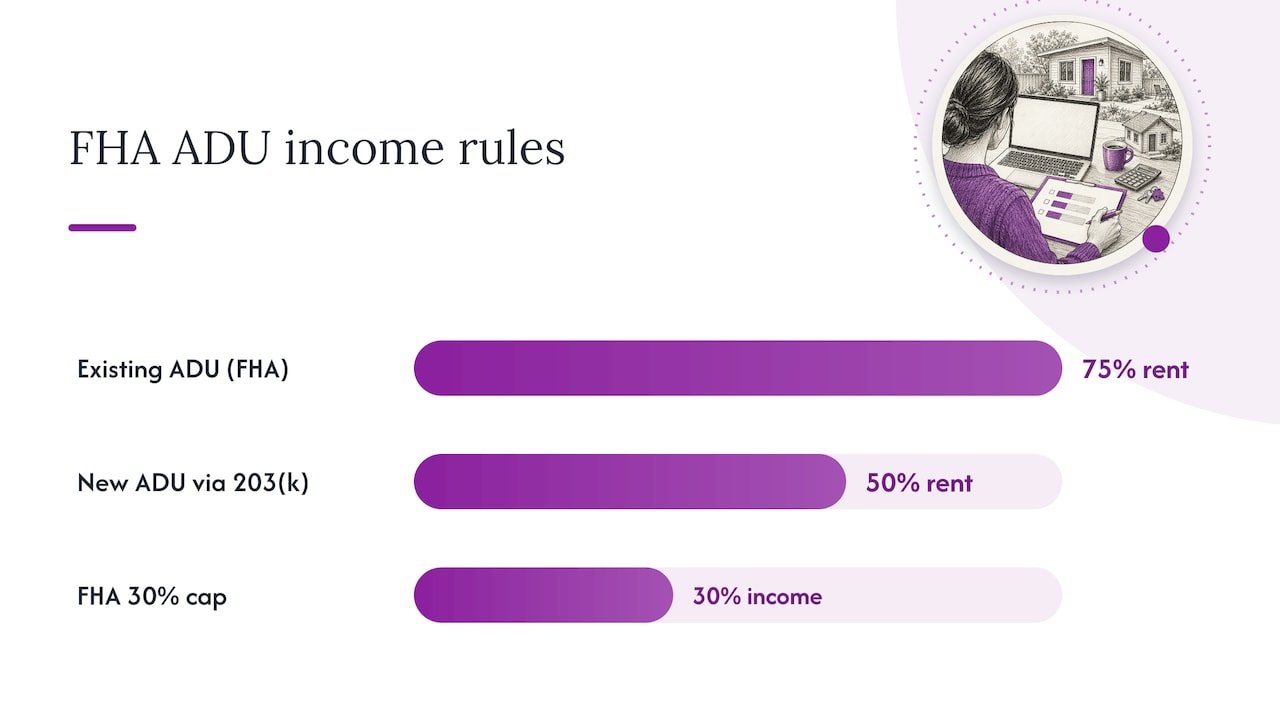
Federal housing policy changed in 2023 specifically to make accessory dwelling units easier to finance. HUD announced that FHA expands access to mortgage financing for homes with ADUs, allowing lenders to count projected ADU rental income toward a borrower’s qualifying income, generally capped at 30% of the borrower’s total qualifying income. The policy also sets different rules depending on whether the ADU already exists or is being built as part of the loan.
Program-specific percentages matter here. FHA informational guidance on ADU rental income allows lenders to count 75% of estimated rent for some existing ADUs, while new ADUs financed through a 203(k) renovation loan are limited to 50% of projected rent. Fannie Mae and Freddie Mac have parallel but separate rules, so the exact percentage depends on which agency backs your loan.
Appraisers play a central role in whether that income actually counts. Freddie Mac’s ADU fact sheet requires appraisals to include comparable rentals and a written description of the ADU, and appraisers typically need at least three comparable rentals plus one comparable sale that also includes an ADU. In markets where few homes have ADUs, finding that one comparable sale can be the hardest part of the process.
Before you apply, gather the documents a lender or appraiser will ask for:
- An executed lease, or market rent comparables if the unit is not yet rented.
- Proof of legal zoning and permits showing the ADU is a conforming structure.
- Evidence of habitability: a separate entrance, a kitchen, and a bathroom.
- Square footage and a written description of the ADU for the appraisal file.
Underwriting can still stall even with everything in order. Automated valuation models frequently reject properties with ADUs because they lack local comparables, and some loan programs restrict ADU income to owner-occupied properties only. An unpermitted or illegal ADU typically cannot be used to qualify at all, regardless of how much rent it generates.
What rent can you realistically expect, and what moves it?
Rent ranges vary enormously by market, but a few patterns hold nationally. A studio or junior ADU converted from a garage or basement tends to rent lower than a detached unit with a full bedroom, while a detached one or two bedroom ADU commands the highest long-term rent in most metros. Short-term rentals can post higher nominal nightly revenue, but industry investment analysis notes that experienced owners tend to prioritize payback period and cash-on-cash return over headline rent, and cheaper conversions often win on that basis despite lower absolute dollars.
A handful of factors move local ADU rent more than anything else:
- Proximity to transit, major employers, or a walkable commercial district.
- The depth of existing rental supply in the neighborhood.
- Unit finish quality and square footage relative to comparable units.
- Whether the local market has strong demand for smaller, single-occupant housing.
To build your first-pass estimate, pull active listings from Zillow and Craigslist, check local property management company rent rolls, search MLS rental history if your agent has access, and review city housing reports where available. Investopedia’s overview of accessory dwelling units frames an ADU as a hybrid asset: it boosts monthly cash flow while staying tied to the value and risk profile of the primary residence, so your rent research should inform both your loan application and your sense of the property’s overall worth.
Lenders and prudent investors both prefer conservative numbers.
How do you model cash flow and returns before you build?
A pro forma turns a rent estimate into a real financial decision. Work through it in order:
- Start with gross rent: your conservative monthly or annual estimate from local comps.
- Subtract a vacancy reserve, typically 5% to 8% of gross rent.
- Subtract operating expenses: insurance, maintenance, utilities if included, and management if you use a property manager, often 25% to 40% of effective rent combined.
- The result is net operating income, or NOI.
- Subtract debt service (the loan payment tied to the ADU, if financed separately) to get your actual cash flow.
Two quick examples show how structure changes the math. Say a garage conversion costs $40,000 and rents for $1,200 a month. A detached new build costing $180,000 and renting for $1,800 a month produces higher NOI in dollar terms, around $13,900 a year, but a payback period closer to thirteen years. The cheaper conversion wins on speed of return even though the detached unit generates more absolute rent.
Cap rate (NOI divided by total project cost) and cash-on-cash return (annual cash flow divided by cash actually invested) tell you different things: cap rate measures the asset’s performance independent of financing, while cash-on-cash reflects your actual out-of-pocket return.
If the project still cash flows under all three stress tests, it is a durable investment rather than a spreadsheet that only works in a best-case scenario.*
Which financing options make sense for an ADU?
The right financing route depends on how much equity you already have and whether you are converting existing space or building new. A HELOC offers flexibility and fast access to funds for smaller conversions, but it carries a variable rate and uses your home as direct collateral. A cash-out refinance locks in a new rate on your entire mortgage, which can work well if rates are favorable but resets the terms on your whole loan balance. Portfolio loans from local or regional lenders can offer more flexible underwriting for borrowers with unconventional income or multiple properties, though often at a higher rate.
Whichever route you choose, the appraisal is where qualification is won or lost. Appraisers need a sales comparison approach that includes at least one comparable sale with an ADU, rental comparables supporting the projected income, and a written ADU description covering square footage and amenities. A local ADU checklist built around parcel-level research is a useful model for understanding how jurisdictions evaluate habitability and comparables before you even apply.
Build a borrower packet before you walk into a lender’s office:
- Site photos showing the ADU’s entrance, kitchen, and bathroom.
- A short memo of comparable rents with addresses and screenshots.
- Copies of permits and zoning approval.
- A one-page construction spec sheet if the ADU is new or recently finished.
Pro Tip: Call your appraiser’s office before the appraisal date and ask whether they have handled ADU properties before. A specialist who already knows your market’s ADU comparables will move faster and push back less than someone encountering one for the first time.
How do you report ADU rental income on your taxes?
Rental income from an ADU is generally reported on Schedule E, according to IRS guidance on rental real estate income and deductions, unless you rent the unit for fewer than 15 days in the year, in which case the income is not reportable at all. Most owners use cash-basis accounting, reporting rent when received and expenses when paid, which keeps the math simple for a single rental unit attached to a primary residence.
Deductible expenses commonly allowed include:
- Mortgage interest allocable to the rental portion of the property.
- Property taxes and insurance premiums, prorated by square footage or usage.
- Repairs and maintenance performed on the rental unit.
- Depreciation on the ADU’s value, separate from the primary residence.
The same IRS guidance confirms that good recordkeeping is not optional: keep your lease, rent deposit records, repair invoices, insurance bills, utility statements, and your original appraisal, since all of these support your deductions if your return is ever reviewed.
Where you live affects the picture further. State tax treatment of rental income varies widely, and higher earners may owe the Net Investment Income Tax on rental profit. Depreciation recapture when you eventually sell the property, and passive activity loss limits if your rental shows a paper loss, are both areas where a tax advisor earns their fee. Treat this section as a starting map, not a substitute for a professional who can see your full return.
What should you budget for construction and soft costs?
Build costs vary by ADU type more than almost any other factor in your pro forma. A garage or interior conversion tends to sit at the lower end of the cost spectrum since it reuses existing walls, foundation, and roofline. An attached addition costs more because it requires new structural work tied into the existing home. A detached new-construction ADU is typically the most expensive option, since it needs its own foundation, roof, utility connections, and site work from scratch.
Your budget needs to cover more than framing and finishes:
- Site prep and foundation work, including grading if the lot slopes.
- Utility connections: water, sewer or septic, electrical, and often a separate meter.
- Interior finishes: flooring, cabinetry, fixtures, and paint.
- Permits, design fees, and required inspections.
- Local impact fees, which some jurisdictions waive for ADUs and others do not.
Before you sign anything, walk the site looking for red flags: a lot that needs regrading, a septic system that may need expansion, or a utility line that has to be extended from the street, since any of these can add thousands before the first wall goes up.
Pro Tip: Get three contractor bids, confirm permit review timelines with your local planning department before you set a move-in date, and factor interest on your construction loan into your total project cost, since that carrying cost is easy to forget and can erode your first year of returns.
How should you manage tenants, vacancy, and risk once it’s rented?
Long-term rentals produce steadier, lower-maintenance income, while short-term rentals can post higher nightly rates but come with real tradeoffs. Background sources suggest that short-term rentals often show higher revenue on paper, but added regulatory compliance, insurance requirements, and hands-on management frequently erode that advantage, which is why underwriting on long-term rent math first is the safer approach.
- Screen tenants carefully and use a lease that spells out maintenance responsibilities and shared-utility arrangements with the main house.
- Keep a vacancy reserve of 5% to 8% of annual rent and a separate capital reserve of 5% to 10% for larger repairs.
- Tell your insurer you have a rental unit on the property. Standard homeowner’s policies often exclude rental activity, and landlord coverage closes that gap.
- Watch for red flags before you commit: construction without permits, HOA covenants that restrict accessory units, local short-term rental bans, or rent-control rules that limit how much you can raise rent annually.
What our research tells us about prefab ADUs
Some builders using structural insulated sandwich panels can assemble a home office or rental unit in days rather than months, a timeline advantage that matters directly to the cash flow math above: every month a unit sits unfinished is a month of rent you never collect. These panels combine structure and insulation in one component, which tends to improve energy performance compared with stick-built walls assembled on site.
The honest tradeoff is that a faster build does not eliminate the appraisal and permitting work described earlier. A quicker assembly timeline shortens your path to a signed lease, but it does not substitute for zoning approval or a lender’s documentation requirements.
— Kian
Build your ADU faster with a prefab kit designed for rental income
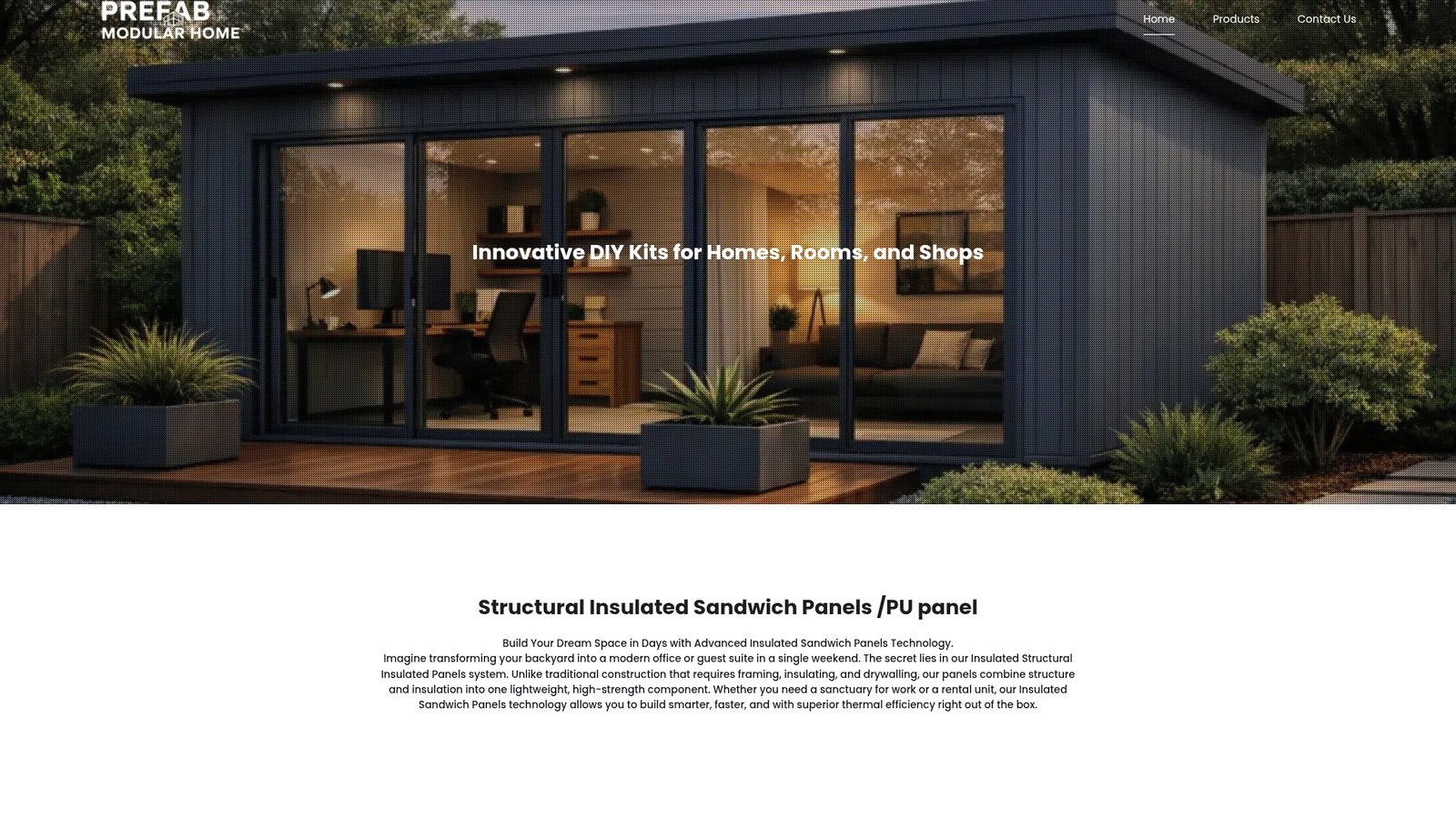
DIY kits can be designed around the same bottleneck that costs ADU owners the most money: time between breaking ground and signing a lease. Insulated sandwich panels combine structure and insulation into one assembly step, which cuts on-site labor and tends to lower soft costs compared with a stick-built addition, and such kits require no special skills to put together.
- Browse our full kit and container catalog to compare options sized for a backyard rental unit.
- Review the insulated panel specifications that support the energy claims in your rent and expense projections.
- Read our breakdown of whether a DIY modular build fits your project before you commit to a kit.
If you are ready to move from spreadsheet to site plan, request a quote on our products page and get a floor plan matched to the rental income model you just built.
FAQ
How to generate income with an ADU?
You generate income by renting the unit long-term or short-term once it is built, permitted, and move-in ready, and by documenting market rent so a lender can count a portion of it toward your mortgage qualification. The FHA’s 2023 policy update specifically expanded access to financing homes with ADUs for this reason.
What is the 30% rule for ADU rental income?
The exact percentage of rent counted also varies by program, with existing ADUs and new 203(k) builds treated differently.
What are the income limits for renting an ADU in Loudoun County?
Specific county-level income or rent limits for renting an ADU are not covered by federal housing or appraisal guidance, and local rules vary by jurisdiction. Check with your local planning department directly, since zoning and affordability requirements for ADUs are set at the municipal or county level rather than nationally.
Can I rent out an ADU on my property?
In most cases yes, provided the unit is legally permitted and zoned for residential occupancy, since an unpermitted ADU typically cannot be used to qualify for financing or rented without risk. Confirm zoning, permits, and any local short-term rental restrictions with your planning department before advertising the unit.
Do I have to report ADU rental income on my taxes?
Yes, in almost all cases rental income must be reported, generally on Schedule E, according to IRS guidance on rental real estate. The one exception is renting the unit for fewer than 15 days in a year, which does not need to be reported at all.
Sources
Recommended
- How a Prefab Spare Room Addition Can Work – Modular Homes with Structural Insulated Sandwich Panels
- DIY Flat Pack House Kits: What to Plan First – Modular Homes with Structural Insulated Sandwich Panels
- Choosing an Insulated Backyard Room Kit – Modular Homes with Structural Insulated Sandwich Panels
- Prefab Studios: A Practical Space Solution – Modular Homes with Structural Insulated Sandwich Panels