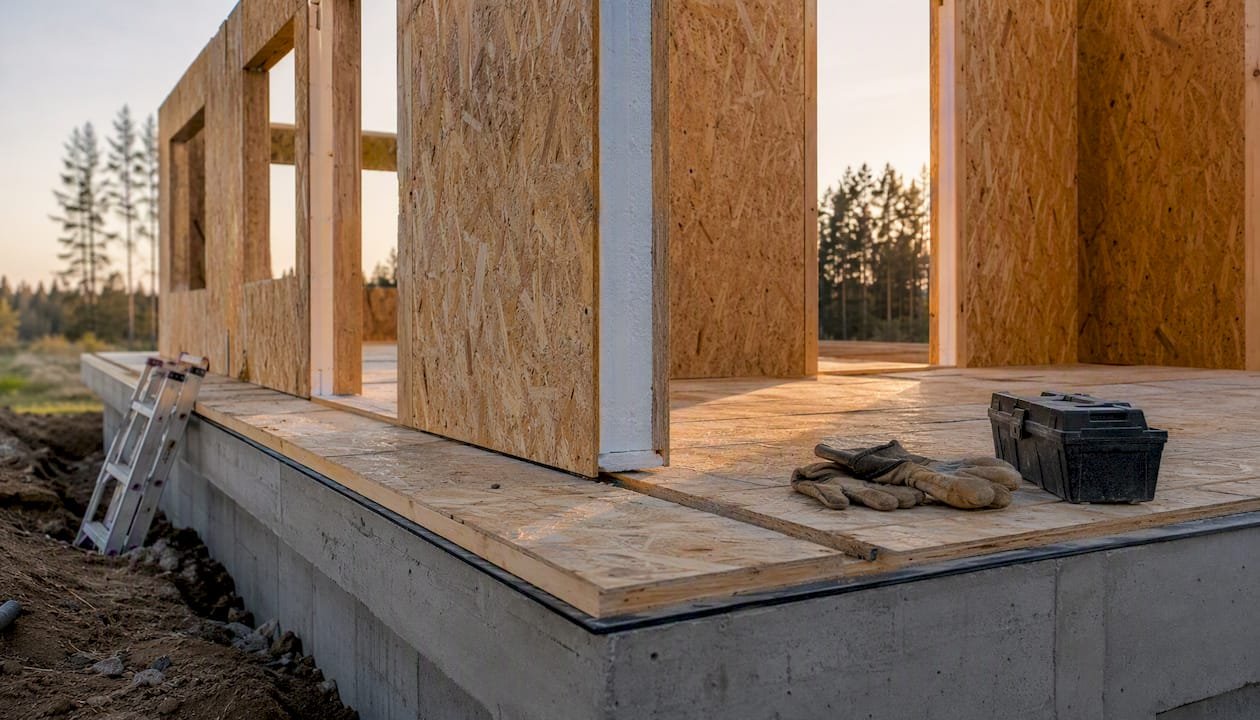
A completed modular or SIP-panel home that sits on a permanent foundation and meets local building codes generally qualifies for a standard homeowners policy form similar to the HO-3, which is used for site-built houses. That single fact is what most buyers need to hear first. Your immediate next step: call an independent agent, ask for an HO-3 quote, and bring three documents to the conversation.
- Manufacturer specification sheet (panel type, structural ratings, assembly method)
- Foundation certification (permanent foundation, not a tie-down pad)
- Local building permit and inspection sign-off confirming code compliance
Tell the agent: “This is a modular home built to local IRC/IBC codes on a permanent foundation. I need an HO-3 quote and confirmation that the policy form reflects modular, not manufactured, classification.”
Key Takeaways
A properly documented modular home built to local codes on a permanent foundation is eligible for a standard HO-3 homeowners policy at premiums comparable to site-built houses.
| Point | Details |
|---|---|
| HO-3 is the right policy form | Modular homes on permanent foundations built to local codes qualify for standard HO-3 coverage. |
| Builders risk covers the gap | Standard homeowners policies don’t activate until completion; builders risk or inland marine covers transit and assembly. |
| Documentation drives classification | Foundation certificate, manufacturer spec sheet, and permit sign-offs are the three documents that prevent misclassification. |
| New-construction credits reduce cost | Ask every agent explicitly for new-construction credits; many carriers offer them for up to five years. |
| Prefabmodularhome supplies the paperwork | Kits include manufacturer specs, panel ratings, and permit guidance — the core insurer-ready packet. |
Table of Contents
- Why prefab and SIP modular homes qualify for standard homeowners insurance
- What a standard HO-3 policy covers for your modular home
- Common add-ons and coverage gaps to consider
- How to insure a modular home during construction and transport
- What insurers look for when underwriting your modular home
- How much does modular home insurance cost?
- A practical checklist to get your modular home covered
- The right questions to ask your insurance agent
- Policy exclusions and red flags to watch for
- How Prefabmodularhome helps customers get insured
- An editor’s perspective on modular home insurance
- Prefabmodularhome kits come with insurer-ready documentation
- Sources
Why prefab and SIP modular homes qualify for standard homeowners insurance
Modular homes are built in factory sections, assembled on a permanent foundation, and follow local and state building codes rather than a single federal standard. That distinction is the underwriting trigger. Insurers classify properties by the code they were built under, and a home built to the International Building Code or International Residential Code lands in the same risk bucket as a stick-built house next door.
Factory construction adds a quiet advantage. Controlled-environment assembly reduces moisture intrusion during framing, and engineered connections meet tighter tolerances than most field-built work. Some carriers recognize this with lower relative rates or endorsement credits because the structural quality is verifiable, not assumed.
SIP-panel homes follow the same logic. Insurers underwriting SIP construction focus on panel fire performance, moisture sealing, and the availability of local contractors for repairs — not on the panel format itself. A well-documented SIP build clears those questions quickly.
Insurers classify homes based on which building code the property was built under. Providing code and foundation evidence is what gets you the correct policy.
Pro Tip: The single most persuasive document when shopping for modular home insurance is the modular certification label or manufacturer’s data plate combined with a signed foundation certificate. Carry both to every agent appointment.
- Permanent foundation (poured concrete, block, or engineered pier system)
- Local/state building-code compliance certificate
- Modular certification label or manufacturer data plate
- Inspection sign-offs at each construction phase
What a standard HO-3 policy covers for your modular home
Most modular homes are insured with a standard HO-3 policy and face premiums comparable to site-built houses. The HO-3 form covers the dwelling on an open-peril basis, meaning it pays for any cause of loss not specifically excluded. For a modular assembly, that protection activates once construction is complete and the home is occupied.
Core HO-3 coverages:
- Dwelling: Structural damage to walls, roof, floors, and attached structures from fire, wind, hail, and most sudden losses
- Personal property: Named-peril coverage for furniture, appliances, and belongings inside the home
- Liability: Pays if someone is injured on your property and sues
- Other structures: Detached garages, fences, and outbuildings up to a percentage of dwelling coverage
- Loss of use: Hotel and living expenses if a covered loss makes the home uninhabitable
Replacement-cost valuation matters more for modular homes than many buyers realize. Factory-built components, SIP panels, and engineered connectors have longer lead times than standard lumber. An actual-cash-value settlement after a major loss could leave you short by tens of thousands of dollars while you wait for replacement materials.
Confirm replacement-cost or guaranteed-replacement-cost endorsements on every quote. Actual-cash-value policies depreciate the payout; replacement-cost policies pay what it actually costs to rebuild with like materials.
Common add-ons and coverage gaps to consider
The HO-3 form leaves several exposures uncovered that modular homeowners encounter more often than typical buyers.
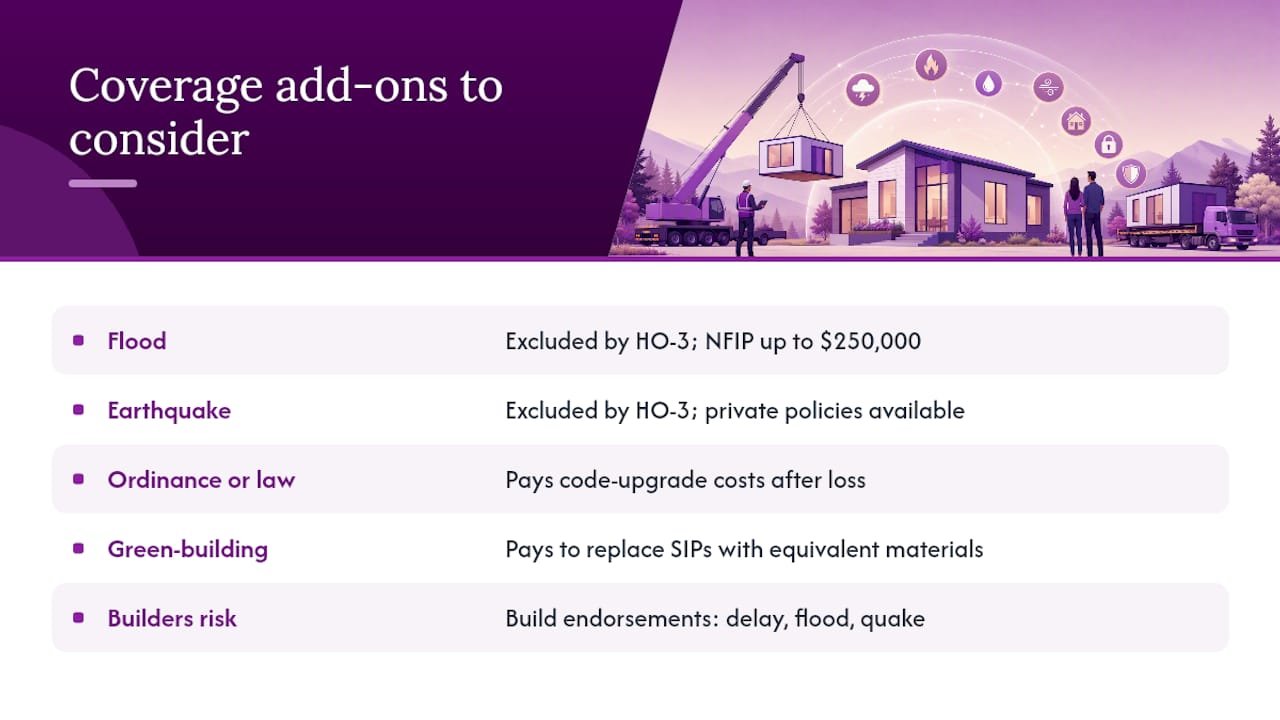
Flood and earthquake are excluded from every standard homeowners policy. The National Flood Insurance Program (NFIP) provides federally backed flood coverage up to $250,000 on the structure; private earthquake policies are available through specialty carriers and are worth pricing if you are in a seismic zone.
Ordinance or law coverage pays the cost to bring a repaired structure up to current building codes after a covered loss. For modular homes, this matters because local codes evolve and a partial rebuild may trigger code-upgrade requirements that a basic HO-3 won’t fund.
Green-building endorsements can reimburse the premium cost of replacing damaged SIP panels or energy-efficient systems with equivalent materials rather than standard alternatives.
Builders risk programs can include optional endorsements for delay, flood, earthquake, and other catastrophe exposures relevant to modular construction, so the gap-filling conversation starts before the home is finished.
Pro Tip: Prioritize flood coverage (NFIP or private) if you are in a FEMA-designated flood zone, earthquake coverage if you are in California or the Pacific Northwest, and ordinance or law if your municipality has updated its building code in the last decade.
How to insure a modular home during construction and transport
A standard homeowners policy does not activate until construction is finished and the home is occupied. Owners should coordinate builders risk or inland-marine coverage for the transport and assembly phase to avoid a gap that could leave modules, materials, and partially assembled structures completely uninsured.
Builders risk basics: A course-of-construction policy covers the structure and materials from groundbreaking through completion. For modular projects, that includes modules while they sit at the factory staging area, during transport on flatbed trucks, and through on-site assembly.
US Assure’s builders risk program for new home construction is a widely cited example of a single-structure residential program. Great American’s residential construction program offers broad valuation options and extensions that matter for reinstatement logistics on modular projects. Both illustrate the kind of coverage features worth comparing when you shop.
Who buys what:
- Owner-builder: Purchase your own builders risk policy; confirm it covers transit from the factory
- General contractor: Verify the GC’s policy extends to your specific site and covers modular modules in transit
- Module manufacturer/carrier: Confirm the manufacturer’s cargo insurance covers damage during loading and transport; get a certificate of insurance before delivery day
Pro Tip: Inspect every module on delivery before signing the carrier’s bill of lading. Photograph all four sides and document any dents, cracks, or moisture intrusion. A signed bill of lading without noted damage can complicate a transit claim later.
Builders risk policies can be structured as single-project, reporting form, or blanket programs — a one-off homeowner project almost always fits a single-structure form.
What insurers look for when underwriting your modular home
Underwriters want to confirm two things: that the home was built to an adopted local code, and that it sits on a permanent foundation. Everything else supports those two points.
Documents to assemble before shopping quotes:
- Modular certification label or manufacturer data plate
- Foundation engineering report or permanent-foundation certificate
- Local building permit (issued before construction)
- Framing and final inspection sign-offs
- Manufacturer specification sheet (panel type, R-values, structural ratings)
- Assembly instructions showing engineered connection details
Physical features underwriters inspect:
- Foundation type (poured concrete slab, full basement, or engineered pier)
- Roof-to-wall and wall-to-foundation connections (continuous load path)
- Panel fire ratings and moisture barrier details for SIP construction
- Utility connections (permanent electrical, plumbing, HVAC)
In Texas and similar states, modular homes that meet local building codes and sit on a permanent foundation are typically eligible for standard homeowners policies; the most common problem is an automated system mislabeling the property as manufactured housing. An independent agent can correct that with the right paperwork.
How much does modular home insurance cost?
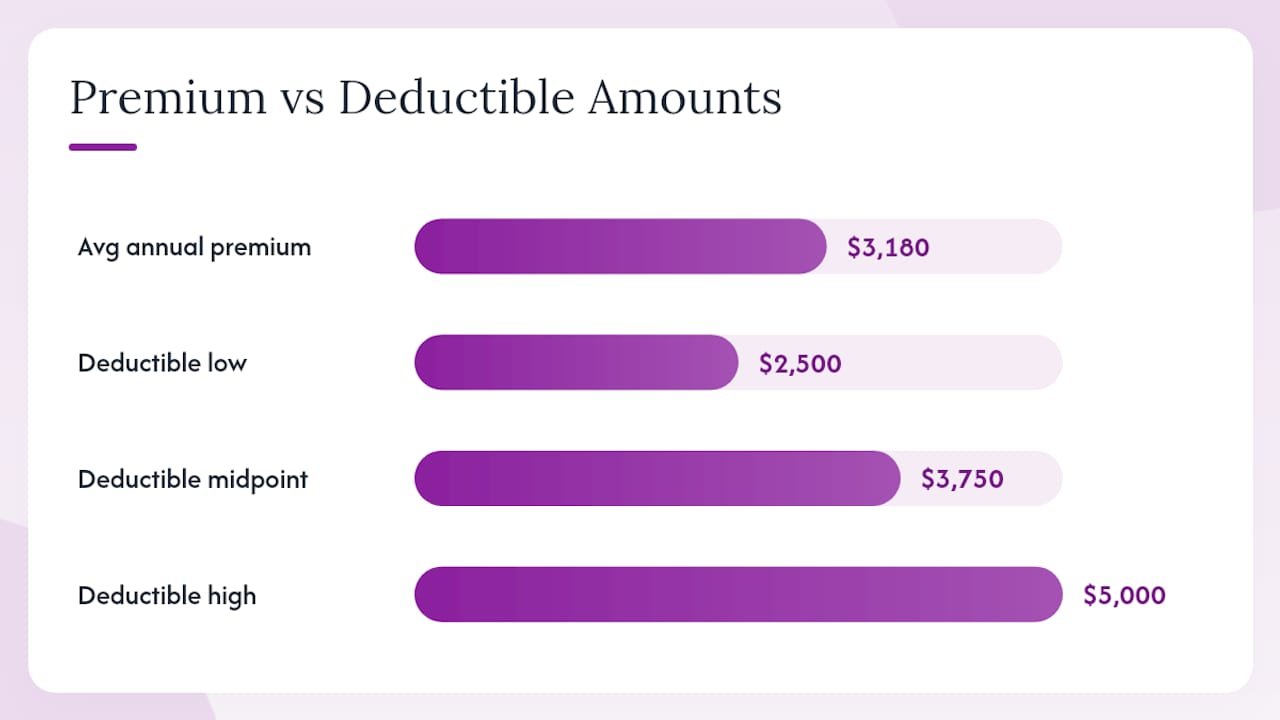
Correct classification and documentation can materially lower premiums; misclassification as manufactured housing pushes rates up significantly. The national average homeowners premium runs roughly $3,180 per year, and modular homes typically land near that figure when properly classified.
Premium drivers:
- Rebuild cost: The primary rating factor; SIP panels and engineered components cost more per square foot to replace than standard framing
- Location: Coastal, flood-zone, and wildfire-adjacent properties carry higher base rates
- Claims history: Prior claims on the property or your personal record raise premiums
- Deductible level: A higher deductible lowers the annual premium; $2,500–$5,000 deductibles are common for modular builds
- Discounts: Bundling home and auto, new-construction credits, smart-home monitoring, and alarm systems all reduce premiums
Many insurers offer new-construction credits for several years when a modular home is rated as new site-built construction… Ask for that credit explicitly — agents don’t always apply it automatically.
A practical checklist to get your modular home covered
Pre-build
- Collect manufacturer spec sheets and modular certification documentation from your kit supplier
- Confirm local building-code approval and pull the building permit
- Purchase builders risk coverage before any materials arrive on site
- Notify your lender; most mortgage lenders require proof of builders risk before closing on a construction loan
During transport and assembly
- Obtain a certificate of insurance from the module carrier confirming transit coverage
- Photograph modules on delivery and note any damage on the bill of lading before signing
- Notify your builders risk insurer of assembly milestones (foundation complete, modules set, roof closed)
At completion
- Schedule the final local inspection and obtain a certificate of occupancy
- Get a permanent-foundation certificate signed by a licensed engineer or inspector
- Contact your agent to bind the HO-3 policy, effective the date the certificate of occupancy is issued
- Cancel or let expire the builders risk policy once the HO-3 is active
The right questions to ask your insurance agent
Bring this list to every agent conversation. Read the questions aloud and write down the answers.
- “Is this quote written on an HO-3 form, and does it classify the home as modular rather than manufactured?”
- “What documents do you need from me to confirm modular classification?”
- “Does the policy cover the home on a replacement-cost basis, and is there a guaranteed-replacement-cost endorsement available?”
- “Is transit or assembly-phase damage covered, or do I need a separate builders risk policy?”
- “What discounts apply — new construction, bundling, smart-home, or alarm systems?”
- “Can I see the declarations page and policy form before binding?”
Get the classification confirmation and coverage form in writing before you pay the first premium. A verbal assurance that “modular homes are fine” is not binding language.
Policy exclusions and red flags to watch for
Common exclusions in standard HO-3 policies:
- Flood damage (requires NFIP or private flood policy)
- Earthquake damage (requires separate earthquake policy)
- Transport-phase damage (requires builders risk or inland marine)
- Code-upgrade costs after a partial loss (requires ordinance or law endorsement)
Underwriting red flags that raise premiums or trigger declinations:
- Missing foundation certification (the single most common reason for misclassification)
- Incomplete inspection records or missing permit sign-offs
- SIP panels without documented fire ratings or moisture barrier specs
- No local contractors listed who can repair the specific panel system
If your insurer misclassifies the home:
- Request the underwriter’s classification rationale in writing
- Submit the foundation certificate, modular certification label, and local building permit together
- Ask the agent to resubmit as a site-built-equivalent modular home
- If the carrier won’t reclassify, shop an independent agent who specializes in modular or non-standard construction
How Prefabmodularhome helps customers get insured
Getting insured faster often comes down to having the right paperwork on day one. Prefabmodularhome’s DIY prefab kits come with the documentation that underwriters ask for most: manufacturer specification sheets, structural insulated panel ratings, assembly instructions with engineered connection details, and guidance on the permit process.
Documents Prefabmodularhome provides with its kits:
- Manufacturer specification sheets (panel type, R-values, structural ratings)
- Assembly instructions with connection details insurers review for load-path continuity
- Panel fire and moisture performance data
- Guidance on modular home permits and local inspection requirements
That packet shortens the underwriter’s review because the classification questions are answered before the agent even picks up the phone.
Pro Tip: The document insurers ask for most often is the manufacturer specification sheet showing panel structural ratings. Prefabmodularhome includes this with every kit order — keep a digital copy in your insurance file from day one.
An editor’s perspective on modular home insurance
The conventional wisdom says modular homeowners face an uphill battle with insurers. That’s mostly outdated. The real friction isn’t insurer hostility — it’s paperwork gaps. Buyers who show up with a foundation certificate, a manufacturer spec sheet, and a permit sign-off get HO-3 quotes the same day. Buyers who show up empty-handed get misclassified, pay manufactured-home rates, and then spend weeks correcting it.
The builders risk gap is where people genuinely get hurt. A module damaged in transit with no coverage in place is a five-figure loss with no recourse. That phase deserves as much attention as the permanent policy, and it gets a fraction of it in most buyer conversations.
The other underrated move: ask for the new-construction credit. Carriers offer it. Agents don’t always apply it. Five years of discounted premiums on a home that qualifies is real money left on the table when nobody asks.
Prefabmodularhome kits come with insurer-ready documentation
Buyers who skip the documentation scramble get to the quote stage faster. Prefabmodularhome’s modular kits ship with the exact spec sheets, panel ratings, and assembly documentation that underwriters need to classify a SIP-panel home correctly the first time. No chasing the manufacturer for a data sheet weeks after delivery.
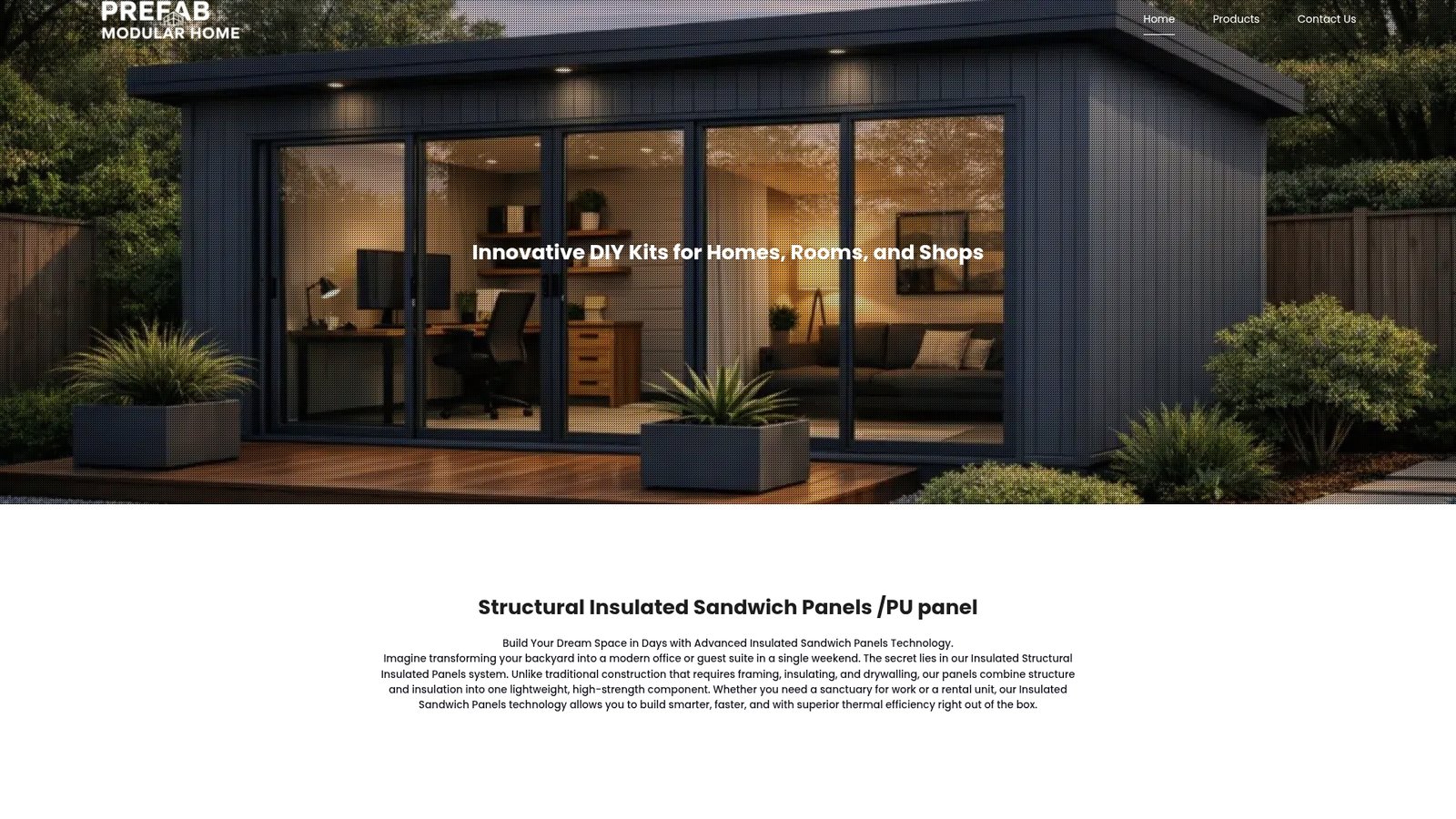
The full product catalog includes downloadable specification sheets for every kit, and the permit guidance page walks through the inspection checkpoints that generate the sign-offs agents want to see. If you are ready to move from planning to quoting, browse the catalog and download your kit’s spec sheet to bring to your first agent appointment.
Sources
- Manufactured vs. Mobile vs. Modular Home Insurance | SoFi Learn
- Modular Home Insurance | EverQuote
- Mobile, Manufactured & Modular | GEICO
- US Assure Builders Risk Plan — New Home Construction
- Homebuilders builders risk coverage | Chubb
- Great American — Builders risk: Residential construction
- Lowering modular home insurance in 2026: Tips, discounts and classification | Coverage Classroom
- Modular Home Insurance – Top Expert Guide (2026) | HomeInsureGuide
Consult an independent agent licensed in your state for rules and carrier availability specific to your location.
This article is general information, not a substitute for advice from a qualified financial advisor. Consult a qualified financial professional about your own circumstances before acting on anything here.
Recommended
- Blog Archives – Modular Homes with Structural Insulated Sandwich Panels
- Modular Home Permits: What Your Project Needs – Modular Homes with Structural Insulated Sandwich Panels
- Modular Home Extensions That Fit Real Life – Modular Homes with Structural Insulated Sandwich Panels
- Modular Backyard Office with PU Panel/Sandwich Panel