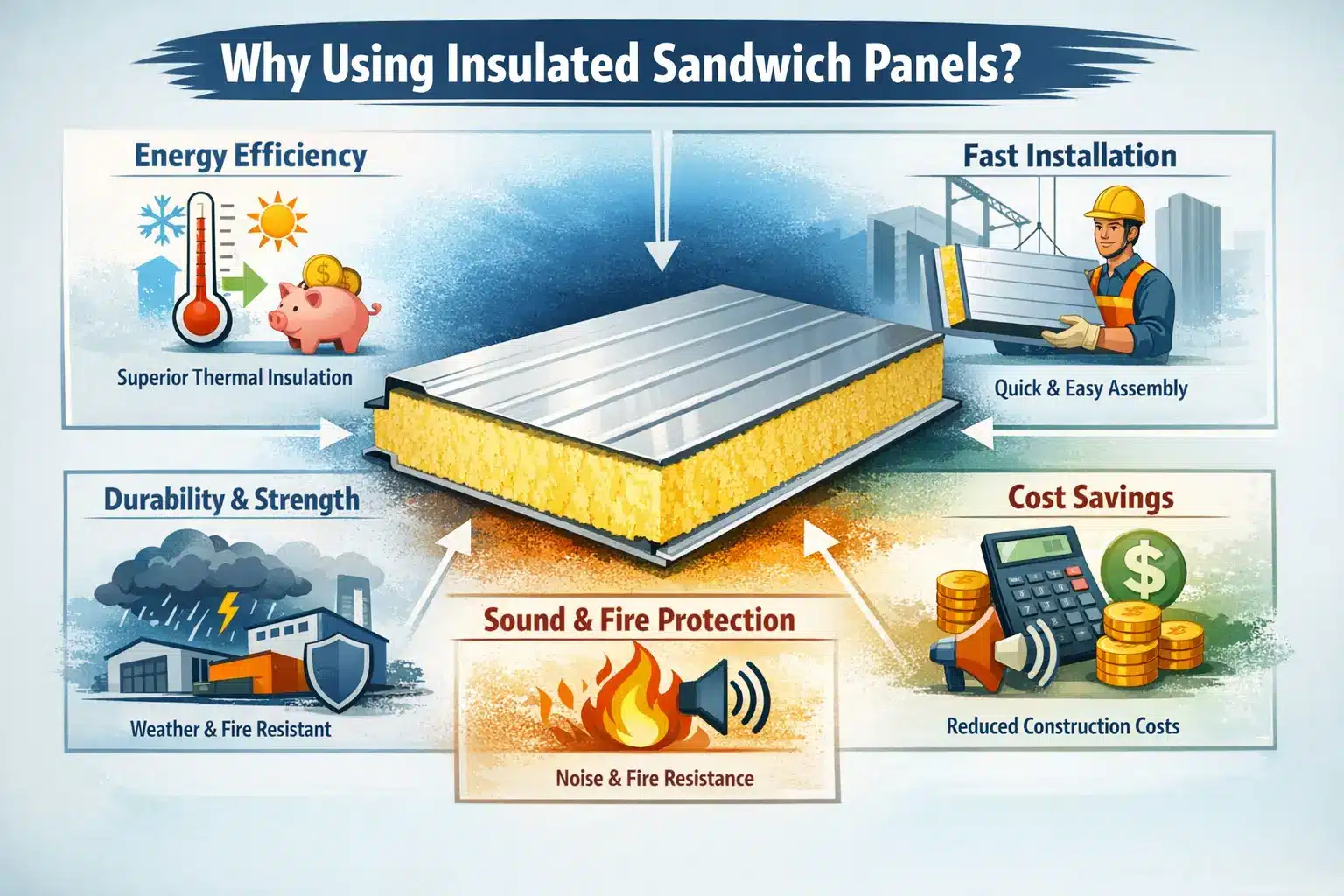
Why Using Insulated Sandwich Panels?
Are you looking for a more efficient and cost-effective way to insulate your building? Sandwich Insulated Panels (SIPs) are a game-changer in the world of construction and insulation. These prefabricated building products consist of an insulating core sandwiched between two layers of structural material. This clever design provides both insulation and structural support, making them a key choice for modern building practices. They’re a fantastic solution for achieving energy efficiency, ensuring stable temperatures, and reducing environmental impact.
The Power of Insulation Panels for Effective Building Insulation
Sandwich Insulated Panels are used for their superior insulation performance, enhanced structural integrity, and the ability to speed up construction projects. They contribute significantly to broader insulation goals, like boosting energy efficiency, maintaining consistent temperatures, and lessening environmental impact. This article dives deep into these incredible building materials, exploring their components, benefits, applications, and how they compare to traditional insulation methods. Let’s delve in!
What are PU Panels?
Many Sandwich Insulated Panels rely on PU panels for their core insulation. Polyurethane, commonly referred to as PU, is a versatile polymer. This means it is a substance with large molecules made by linking many smaller ones together. PU panels are made by reacting a polyol (an alcohol with multiple hydroxyl groups) with an isocyanate (a compound containing an isocyanate group).
These panels function as the heart of insulation in many SIPs. The major benefits of using PU include:
- Excellent Insulation: PU boasts great insulation properties, with a high R-value per inch.
- Durability: PU is strong and resists moisture.
- Lightweight: PU is easy to handle and install.
PU offers an exceptional insulation value, ensuring minimal heat transfer and making buildings more energy-efficient. Because they are lightweight, they make installation easy. This ultimately saves on construction time and cost. For more information, read “The Green Advantage of PU Panels” The Green Advantage of PU Panels to learn how PU panels help build sustainable and energy efficient structures.
Components of Sandwich Insulated Panels
The fundamental design of Sandwich Insulated Panels is straightforward: an insulating core sandwiched between two layers of material. Let’s take a closer look at these core parts.
Core Material
The core is the key to a SIP’s insulation. The most common core material is PU panels. But there are other options too:
- PU Panels: This is the most common core choice, which is described above. The density of the PU impacts its R-value, and the inclusion of fire-retardant additives increases its fire resistance.
- Expanded Polystyrene (EPS): EPS is a cost-effective option, offering reasonable insulation value. However, it is not as moisture-resistant as other options.
- Extruded Polystyrene (XPS): XPS offers high moisture resistance, making it suitable for areas where water exposure is a concern.
- Mineral Wool: Mineral wool, often made of rockwool or stone wool, provides excellent fire resistance and soundproofing properties.
Facing Materials
The exterior layers, or facing materials, offer protection and structural integrity. Common options include:
- Steel: Steel facings, especially pre-painted galvanized steel, give the panel durability and structural strength.
- Aluminum: Aluminum facings are lightweight and resist corrosion, which is a great choice for certain environments.
- Fiberglass-Reinforced Plastic (FRP): FRP offers a high strength-to-weight ratio and is often used in specialized applications.
Other materials that can be used are: Plywood, OSB (Oriented Strand Board), Magnesium Oxide Boards, and Cement Boards.
The facing materials safeguard the core. They are responsible for withstanding external forces and maintaining the panel’s structural integrity, allowing the core to effectively provide insulation.
Benefits of Using Insulation Panels
Insulation panels offer advantages over older insulation methods. They are known for energy efficiency, temperature regulation, and significant cost savings.
Energy Efficiency
Insulation panels significantly reduce heat transfer. This means they limit both conductive and radiative heat loss or gain. They provide superior insulation because of their high R-value. This directly translates to significant energy savings, reducing energy bills and your carbon footprint. PU panels specifically are highly effective at providing insulation.
Temperature Regulation
SIPs help create a stable indoor climate. They reduce drafts and hot or cold spots, promoting comfort for building occupants. This is a noticeable improvement, making the indoor environment more livable year-round.
Cost Savings
The benefits of SIPs extend to the financial realm:
- Reduced Energy Bills: Lower heating and cooling costs are a direct and immediate saving.
- Government Incentives: You may be eligible for rebates and incentives for using energy-efficient insulation panels.
- Increased Property Value: Energy-efficient buildings are often valued higher, enhancing the long-term return on your investment.
Additional Advantages
Beyond the core benefits, insulation panels offer several additional advantages:
- Faster Construction Times: Prefabricated nature cuts down on construction time.
- Lightweight Nature: Making them easier to handle, and less of a burden on building structures.
- Enhanced Durability: Resist moisture, pests, and the elements, leading to longer lifespans.
Applications of Sandwich Insulated Panels
Sandwich Insulated Panels are versatile, which means they can be used in numerous building scenarios.
Construction
- Walls: SIPs are used for both exterior and interior walls in homes and commercial buildings. They deliver rapid construction and remarkable energy efficiency.
- Roofs: High insulation value and structural integrity make them a great choice for roofs.
- Floors: They are used in floors to provide insulation and comfort, leading to energy-efficient living spaces.
Cold Storage/Refrigeration
- Walk-in Freezers/Coolers: Perfect for creating insulated environments for preserving food.
- Refrigerated Trucks/Trailers: Critical for maintaining consistent temperatures during transportation.
Industrial Buildings
- Warehouses and Factories: SIPs are commonly used in industrial settings.
Specialized Applications
- Clean Rooms: SIPs help maintain controlled environments where environmental regulations are extremely important.
- Modular Housing: They are perfect for faster, and more efficient building construction.
Sandwich Insulated Panels vs. Traditional Insulation
Sandwich Insulated Panels, PU panels, and insulation panels offer benefits, but it’s important to understand how they stack up against traditional insulation methods. Traditional methods include fiberglass batts, blown-in cellulose, and spray foam.
Insulation Performance (R-values)
SIPs, especially those with PU panels, often boast higher R-values. This means better insulation performance compared to many traditional methods.
Installation Complexity
SIPs are generally easier and faster to install than traditional methods.
Labor Costs
The easier installation of SIPs often leads to lower labor costs.
Airtightness
SIPs are frequently more airtight, reducing air leakage and enhancing energy efficiency.
Environmental Impact
Consider the materials and processes to find which methods have the least impact.
Summary Table
| Feature | Sandwich Insulated Panels | Traditional Insulation Methods |
|---|---|---|
| Material | PU, Steel, Aluminum, etc. | Fiberglass, Cellulose, Spray Foam |
| R-value | High | Variable |
| Installation | Easier, faster | More complex, time-consuming |
| Cost | Potentially higher initial cost | Can be lower initial cost |
| Durability | High | Variable |
Installation and Maintenance of Insulation Panels
Proper installation and maintenance are essential for maximizing the lifespan and effectiveness of Sandwich Insulated Panels.
Installation Techniques
- Sealing: Creates a tight seal between panels to stop air and moisture from entering.
- Thermal Bridging: Prevent thermal bridging during installation.
- Attachment Methods: Follow correct methods, using the right fasteners and adhesives.
Maintenance
- Inspections: Schedule regular inspections.
- Repairs: Repair minor damage, such as resealing joints.
- Cleaning: Use appropriate cleaning procedures to maintain appearance and performance.
- Following Manufacturer’s Guidelines: Stick to the manufacturer’s specific guidelines.
Conclusion: Summarizing the Advantages
Sandwich Insulated Panels, and particularly those with PU panels, offer numerous advantages for modern construction. They are known for energy efficiency, maintaining a consistent temperature, cost savings, and structural integrity. They are a game-changer because of the benefits they bring.
PU panels contribute heavily to the overall high insulation value and durability of SIPs. This makes them a great option for building designs that are energy-conscious.
The use of SIPs is growing. By investing in SIPs, you are not just getting an insulation solution, but you are also embracing a more sustainable and efficient building future.