
A garden office stays rodent-free when you do three things: build it off the bare ground, close every gap wider than 1/4 inch with metal or mesh, and keep food, shelter and clutter away from its walls. Repellents and gadgets don’t replace those steps. Most of the work is cheapest before the walls go up, which is why the plan matters as much as the pest control.
This guide covers where rodents get in, how to build and seal against them, what to change in the yard, which deterrents are a waste of money, and what to do if you already see droppings.
TL;DR
- Mice can squeeze through a hole the width of a pencil (1/4 inch, or 6 mm), so every gap larger than that needs sealing.
- Use steel wool, wire mesh, copper mesh or sheet metal at gaps. Rodents gnaw through plastic, foam, wood and caulk alone.
- Set the office on a concrete pad or raised base, and seal where pipes, cables and vents pass through the walls and floor.
- Ultrasonic devices and repellents don’t solve a rat problem. Exclusion is the most successful and longest-lasting approach.
- Check the seals on a schedule, and call a pest-control professional if rodents reach places you can’t get to and clean.
Table of Contents
- How rodents get into a garden office
- Start with the base: keep the floor off bare ground
- Seal every gap that’s larger than 1/4 inch
- Build in rodent-resistant details from the start
- Change the yard, not just the building
- What doesn’t work, and what does
- Inspect on a schedule
- What to do if you find signs of rodents inside
- Perspective: why we plan the envelope first
- Choosing a kit with rodent-proofing in mind
- FAQ
- Sources
How rodents get into a garden office
Rodents don’t need an open door. According to the UC Statewide IPM Program, rats can enter structures by gnawing, climbing, jumping, or swimming through sewers and entering through toilets or broken drains. The same page advises sealing holes larger than 1/4 inch. The CDC puts the mouse figure plainly: a hole the width of a pencil, 1/4 inch or 6 mm, is enough.
A garden office is an attractive target for a few reasons:
- It’s warm and quiet. A heated room that’s empty at night is better shelter than a shed or a hedge.
- It sits close to cover. Overgrown borders, stacked wood and compost give rodents a safe route to your wall.
- It has many small openings. Cable entries, vent holes, the gap under the door and the joint where the wall meets the floor are all typical entry points.
- Food shows up. Desk snacks, a coffee station and bird seed nearby give them a reason to stay.
The EPA’s pest entry prevention bulletin makes a useful point for builders: gaps that leak air also provide routes for pests, so the air-sealing you do for energy efficiency does double duty against rodents. An airtight, well-detailed office is already most of the way to a rodent-resistant one.
Start with the base: keep the floor off bare ground
The first decision happens before any wall goes up. British Columbia’s guide to rodent IPM for residents recommends building outbuildings such as shesheds on concrete pads, not bare ground. That is the simplest rule in the whole topic. A solid, continuous base removes the easiest route: tunneling under the edge of the floor.
What a good base looks like for a garden office:
- A continuous concrete pad or slab that extends to the full footprint of the building, with no soft ground exposed at the perimeter.
- If you use piers or a raised frame, a closed skirt in metal mesh or sheet metal around the underside, fixed tight to the floor frame and buried or fastened to the base so there’s no gap to crawl through.
- A tight junction between the wall base and the floor or pad, sealed with durable material rather than caulk alone.
- Level ground and drainage that keep water from pooling under or beside the building, since standing water is a draw for rodents.
If you are planning a panel-kit office, settle the base type and the perimeter detail first, because they decide how you finish the lower edge of the walls. Our guide to planning garden office security before the panels close covers the order of work, and the DIY flat pack house kit planning guide shows what to prepare on site first.
Seal every gap that’s larger than 1/4 inch
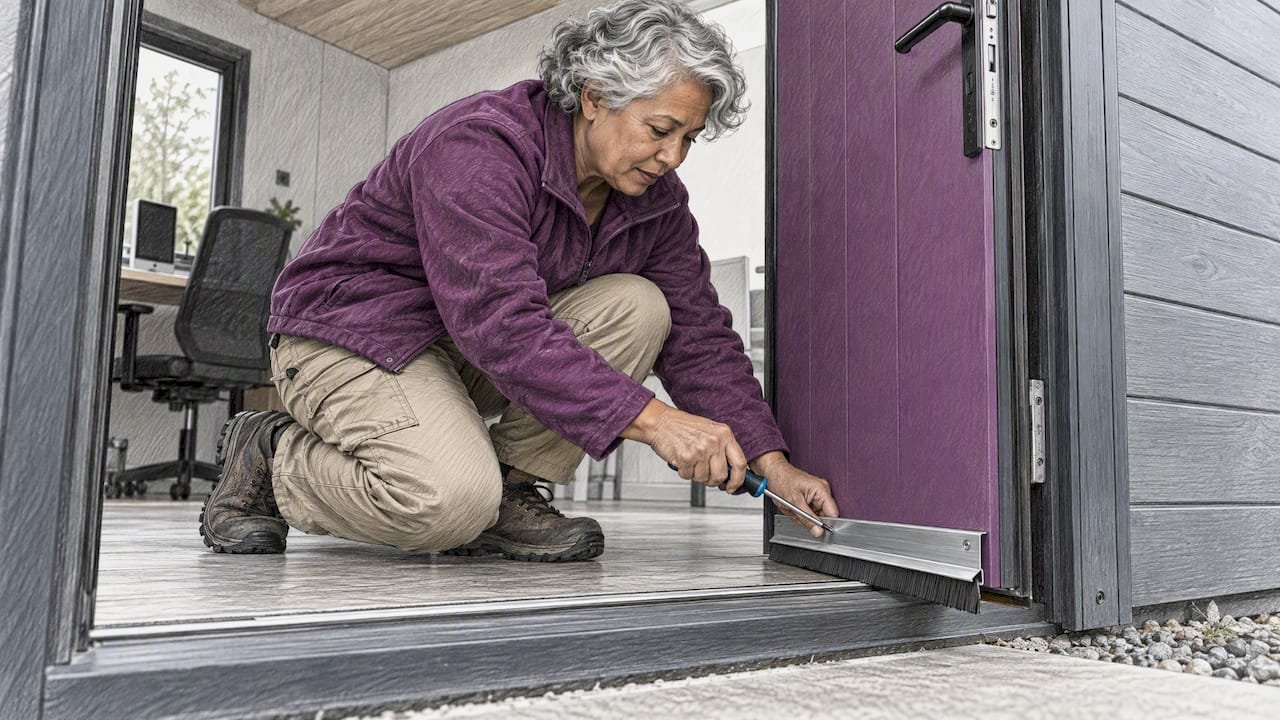
Once the shell is up, walk the inside and outside of the building looking for any opening you could slide a pencil into. The UC IPM guidance recommends sealing cracks and openings larger than 1/4 inch with steel wool, wire screen or sheet metal, making sure doors, windows and screens fit tightly, and installing door sweeps or weather stripping.
Where to look
The British Columbia guide says to inspect and seal structural lines that connect with or enter buildings at any level: utility lines, vents, pipes, sewer lines and drains. In a garden office that translates to a short checklist:
- The power cable or conduit entry, and any data line
- Wall and roof vents, and extractor fan ducts
- Water and drain pipes, if the office has a sink or toilet
- Heat pump or air conditioner line sets
- Window and door frames, especially at the sills
- The joint where the wall meets the floor, and the roof meets the wall
- Any hole drilled during installation and later forgotten
Windows deserve special attention in a panel building, because every opening you cut is an edge you need to finish properly. Our page on windows in panel walls walks through planning, cutting, trimming and sealing them.
What to seal with
This is where many DIY jobs go wrong. The UC Statewide IPM Program notes that rodents can gnaw through building materials including plastic, foam, wood and caulk, so the sealing material has to be durable. NC State Extension lists effective exclusion materials: lath screen, steel wool, copper mesh, wire mesh, galvanized sheet metal and caulk.
In practice, caulk and expanding foam are good for airtightness but shouldn’t be the only barrier. Pack the gap with metal first, then finish over it.
| Gap | Durable fix | Finish |
|---|---|---|
| Small cracks and pipe gaps | Steel wool or copper mesh packed in tightly | Caulk over the metal |
| Vents and air bricks | Wire mesh or hardware cloth fixed over the opening | Metal trim or screws every few inches |
| Wall base and floor edge | Galvanized sheet metal flashing | Sealant at the top edge |
| Large holes | Sheet metal patch screwed to the frame | Sealant around the patch |
| Door gap | Door sweep plus metal threshold | Check the clearance |
For the door, NC State Extension says rodent-proof door sweeps combined with metal thresholds should leave no more than 1/4 inch between the door and the floor. Test it: if you can slide a pencil under the door, so can a mouse.
If you want a second look at how metal exclusion works around a typical home, this guide to metal exclusion for mouse gaps explains the 6 mm gap principle and the materials used to close it.
A realistic cost
Professional exclusion is not always expensive work. A 1994 study of rodent infestations in three National Park units, cited in the National Park Service rodent exclusion manual, found that maintenance crews using standard construction methods could do the exclusion at an average cost of about $600 per structure. That figure is old and the buildings were different, so treat it as evidence that standard tools and materials are enough, not as a quote for your office.
Build in rodent-resistant details from the start
The NPS manual sums up the philosophy of professional rodent management in a line attributed to Gerry Hoddenbach, a former Southwest Regional IPM Coordinator for the Park Service: if you keep them out, they can’t get in. Building a new office is the best time to apply it, because every joint is open and accessible.
- Plan penetrations in one place. Group cables and pipes into one service entry so there’s one detail to seal and one spot to check.
- Sleeve and seal. Pass pipes and cables through a tight sleeve, then pack the gap with steel wool or mesh before sealing.
- Use metal where the wall meets the ground. A metal base trim or flashing along the bottom edge protects the lowest part of the wall, where rodents arrive first.
- Cover vents with mesh behind the grille, not just a plastic louver.
- Choose doors and windows that close tight, and fit the sweep on day one.
- Keep the roof edge tight. Where roof panels meet walls, close the joint and use metal closures at the eaves so there’s no gap for a climber to use.
A panel system helps here because the structure and insulation come as one flat-pack component, with fewer hidden cavities than a stick-built frame with batt insulation. That is our design intent, and it’s the reason we pay so much attention to edges and joints: the panels give you a clean, continuous envelope, and the details at the base, openings and service entries are where you finish the job properly. The insulated wall and roof panels guide explains how the panels connect.
Change the yard, not just the building
Sealing keeps rodents out. Yard habits keep them from showing up in the first place. The CDC recommends keeping outdoor areas clean, trimming grass and shrubbery within 100 feet of your home, storing grains and animal feed in tight-lidded containers, and moving woodpiles at least 100 feet away. It also advises keeping compost bins at least 100 feet from structures and removing bird feeders or using them with care.
British Columbia’s guide adds clearance rules that suit a garden office: prune branches at least 2 meters from balconies, eaves and roofs, cut tall grass and weeds back from buildings, and avoid vines or low-lying cover plants near homes.
For a garden office, that becomes:
- Leave a clear strip around the walls. Gravel or bare soil along the perimeter gives rodents no cover and makes burrows easy to spot.
- Keep climbing plants off the building. Vines are a ladder to the roof edge.
- Cut back overhanging branches so nothing links the tree to the roof.
- Move compost, firewood and feed storage as far from the office as your plot allows. If you can’t reach the 100-foot guidance, get as far as you can and use sealed containers.
- Eat lunch in the house, or clear the crumbs daily. Bins in the office should have lids and be emptied often.
- Store office items off the floor in lidded plastic or metal containers, especially paper, cardboard and cables.
The UC IPM program frames rat management in the same way: remove food and shelter, and reduce entry points into buildings.
What doesn’t work, and what does
Many of the pages ranking for this topic recommend planting mint, scattering coffee grounds or spraying peppermint oil. It’s an appealing idea, because it’s cheap and feels natural. The research is less encouraging. The UC Statewide IPM Program states that exclusion is the most successful and longest-lasting strategy for rat control, that ultrasonic sounds are ineffective, and that repellents don’t solve a rat problem for more than a very short time.
The British Columbia guide does mention that some Indigenous groups historically used plants such as wild mint as a natural deterrent in or around living areas. That’s a cultural practice worth knowing about, but it isn’t a substitute for closing the gaps.
A simple way to spend your money:
| Spend on | Skip or treat as extra |
|---|---|
| Metal mesh, steel wool, flashing | Ultrasonic plug-ins |
| Door sweep and threshold | Scent repellents as the main defense |
| Concrete pad or closed skirt | Decorative planting beside the walls |
| Lidded storage and tidy surroundings | Loose caulk or foam as the only seal |
Inspect on a schedule
Seals age. Metal moves, sealant cracks, soil settles, and a new cable gets added later. The NPS manual advises building exclusion maintenance into your routine inspection schedule, with regular checks of foundations, vents and utility penetrations, and ongoing vigilance for new gnaw marks or degraded seals.
A simple routine that suits a garden office:
- Each season: walk the perimeter, check the base, vents, cable entry and door sweep, and look for burrows, new gaps and gnawing.
- After storms or ground work: recheck the base and any area that was disturbed.
- After any new installation: if an electrician, plumber or installer adds a cable or pipe, inspect the penetration before they leave.
- Before winter: this is when cold weather pushes rodents toward warm buildings, so make it the most careful check of the year.
The CDC’s guide on controlling wild rodent infestations says droppings and gnaw marks are two signs of rodent presence and encourages regular inspection inside and outside a building. Droppings are pointed at one end and often contain hair.
What to do if you find signs of rodents inside
Don’t sweep or vacuum droppings. Dry cleaning kicks dust into the air. Follow the order the CDC cleanup guidance sets out, as reproduced in this university copy of the CDC guidelines:
- Trap and seal first. Trap the rodents and close every entry point. Keep trapping for a week. If you catch nothing, the active infestation is over.
- Ventilate and protect yourself. Wear rubber, latex or vinyl gloves.
- Wet the droppings and urine with a bleach solution or an EPA-registered disinfectant until very wet, and let it soak for 5 minutes or as long as the label says.
- Wipe up with paper towels, and put them in a covered garbage can that’s emptied regularly.
- Mop or sponge hard surfaces with disinfectant, then wash your hands.
Then find out how they got in. Check the base, the service entries and the door first, and fix the cause with metal, not just sealant.
Call a pest-control specialist if rodents have reached areas you can’t reach to clean, as the CDC advises. In a garden office that might mean a void under a raised floor or a closed wall cavity. If you see lots of droppings, or you’re clearing a heavily affected space, a professional has the right protective gear and can confirm the entry points.
Perspective: why we plan the envelope first
Most rodent problems in garden buildings start with the same three things: a soft base, an unsealed service entry and a door gap nobody measured. None of them is exotic, and all of them are cheaper to fix during assembly than after the office is lined, wired and furnished.
That’s why we think about a kit as a continuous envelope, not a pile of parts. Our structural insulated sandwich panels combine structure and insulation in one piece, so there are fewer hidden cavities to worry about and fewer seams to finish. We design our kits so that owners can assemble them without special skills, and that gives you time to focus on the details that matter: the base, the edges, the openings and the cable entry.
Our advice is simple. Decide on your service entry, door sweep and base detail before you order. Use metal at the lowest edge and at every penetration. Write the inspection into your seasonal routine. An office built this way is also tighter and easier to heat, which is the reason people build one in the first place.
Kian
Choosing a kit with rodent-proofing in mind
If you’re still choosing a building, compare on the details that decide how easy it is to seal: how the walls meet the floor, how openings are framed, where the cables enter and whether the roof edge closes tightly. Ask for the connection details before you buy, and plan your metal trim and mesh into the build.
Our DIY kit rooms, gyms and offices are flat-pack insulated panel buildings designed for assembly without special skills or heavy tools, and you can also see the insulated wall and roof panels on their own. If you want to see what a typical backyard build involves, start with our backyard office ideas and the build-time guide.

Tell us what you plan to use the space for and we’ll help you choose a kit and think through the base and service-entry details. Browse the full range on our home page.
FAQ
How small a gap can a mouse get through?
A mouse can fit through a hole about the width of a pencil, which is 1/4 inch or 6 mm. Seal anything larger than that, and test door gaps with a pencil. Use metal, not only caulk or foam.
Can mint or peppermint oil keep rodents out of a garden office?
Not reliably. The UC Statewide IPM Program says repellents don’t solve a rat problem beyond a very short time and that exclusion is the most successful, longest-lasting strategy. Use plants for looks, and metal for defense.
Does a garden office need a concrete base?
A concrete pad is the simplest answer. British Columbia’s residential guidance recommends building outbuildings on concrete pads, not bare ground. If you use a raised frame, close the underside with metal mesh or sheet metal.
What should I do if I find droppings in my office?
Wear gloves, wet the droppings with disinfectant, wipe them up with paper towels and bin them in a covered container. Don’t sweep or vacuum. Then trap, seal the entry points and keep trapping for a week.
When should I call a professional?
Call a pest-control specialist if rodents have gotten into areas you can’t reach to clean, such as a closed floor void or wall cavity. A professional can also help if you can’t find the entry point.
Sources
- Rats, UC Statewide IPM Program
- How to Seal Up to Prevent Rodents, CDC
- Rodent Exclusion Manual, National Park Service
- Surveillance and Management of Common Structure-Invading Rats, NC State Extension
- Indoor airPLUS Technical Bulletin: Pest Entry Prevention, EPA
- Controlling Wild Rodent Infestations, CDC
- CDC Guidelines on Cleaning Up After Rodents
- Seal 6mm Gaps: Mouse Proof Your Home With Metal Exclusion