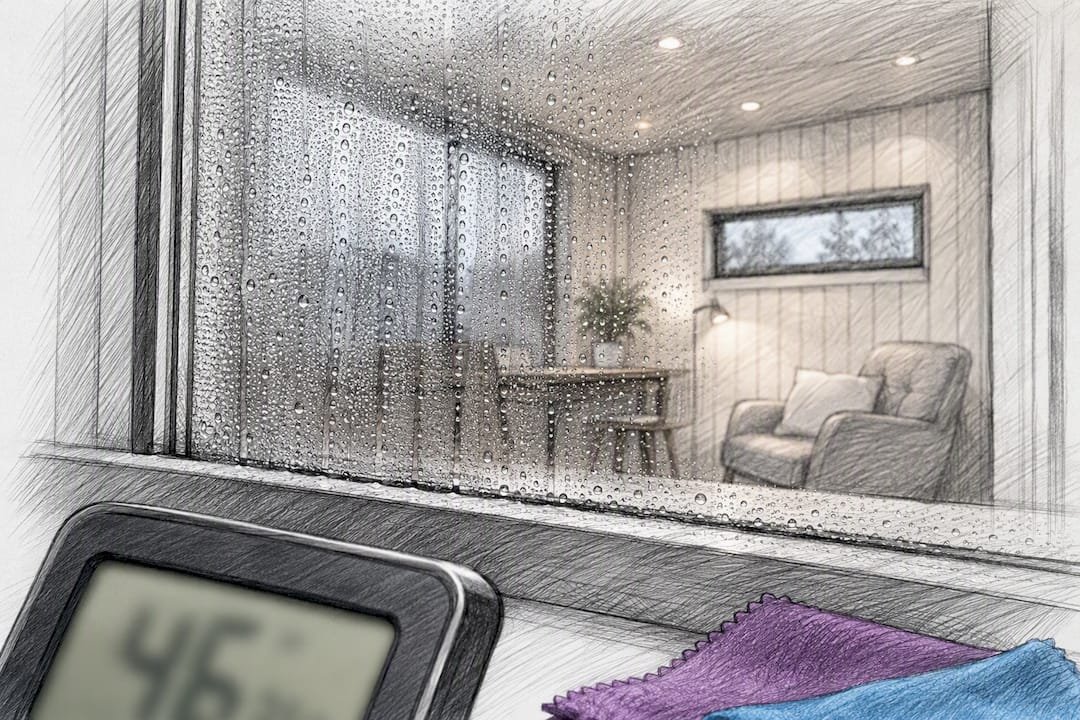
Stopping condensation in a container home or sandwich-panel module comes down to three moves working together: pull excess moisture out of the indoor air, keep a continuous thermal barrier so no surface gets cold enough to sweat, and run controlled ventilation to swap stale, humid air for fresh. Start today by checking your relative humidity with a $15 hygrometer. If it reads above 55%, run a dehumidifier now and inspect marriage joints and penetrations for gaps while you wait on a longer fix, following the three-pillar strategy building scientists recommend. Some companies build that continuity into the panel itself, which saves you from chasing leaks later.
TL;DR:
- Maintaining indoor relative humidity below 55% with a hygrometer and dehumidifier prevents excess moisture that could lead to condensation issues.
- Sealing marriage joints, penetrations, and seams is crucial, as these are the most common pathways for warm, moist air to contact cold surfaces and cause dripping.
- Using continuous insulation, such as factory-built sandwich panels or spray foam, effectively breaks thermal bridges and prevents steel surfaces from sweating.
- In cold climates, installing heat or energy recovery ventilators is recommended, while in humid or small spaces, portable dehumidifiers are often more effective.
- Regular inspections and maintenance of seals, filters, and insulation are vital to keep condensation from returning over time.
Table of Contents
- Priority Checklist to Stop Condensation Fast
- What Insulation Stops Condensation on Steel and Thin Panels?
- Where Do Modular Joints and Seams Leak Warm, Moist Air?
- ERV, HRV, or Dehumidifier: Which Do You Actually Need?
- Is Your HVAC System Actually Making Condensation Worse?
- How Do You Keep Condensation From Coming Back?
- Why Factory-Built Panels Beat Retrofit Fixes Long Term
- Stop Condensation Before It Starts With Continuous Insulation
- Sources
- FAQ
Priority Checklist to Stop Condensation Fast
Work through this in order. Each step either buys you time or fixes a root cause.
- Measure first. A hygrometer tells you relative humidity (RH); dew point calculators (free online) tell you the surface temperature where moisture will start condensing. If indoor RH consistently sits above a safe level for several hours, you have a problem, not just a nuisance.
- Seal what you can see. Check marriage joints between modules, window perimeters, door thresholds, and any wire or plumbing penetration through the shell.
- Fix the short term. Run a dehumidifier, turn on bathroom and kitchen exhaust fans during and after use, and resist the urge to overcool the interior in summer, since a colder surface invites more condensation.
- Know when to escalate. Persistent dampness on a wall or ceiling after sealing and dehumidifying usually means an assembly needs to be opened and inspected by someone who knows modular construction.
Pro Tip: Buy a hygrometer with a memory or min/max function. A single afternoon reading tells you almost nothing; a week of data tells you whether your humidity problem is a leak, a lifestyle habit (long showers, indoor drying racks), or a ventilation gap.
What Insulation Stops Condensation on Steel and Thin Panels?
Bare steel is the worst surface you can ask moist air to touch. It conducts heat fast, drops to outdoor temperature almost instantly, and becomes a condensation magnet the moment humid indoor air reaches it. The fix is not more insulation everywhere. It is continuous insulation with no gaps, especially at the roof and floor, where thermal bridging does the most damage.
- Closed-cell spray foam bonds directly to steel, seals seams as it expands, and adds meaningful vapor resistance. It costs more than open-cell foam and needs a trained applicator, but for retrofitting an existing container, it is often the fastest way to kill condensation at the shell.
- Exterior continuous rigid foam or factory-built sandwich panels move the thermal break outside the structural frame, so studs, ribs, and fasteners never create a cold bridge through the wall. Factory panels also let the wall assembly dry outward instead of trapping moisture between layers, a detail HUD’s moisture guidance for manufactured housing flags as critical in humid climates.
- Panel detailing matters as much as R-value. Spanning over structural ribs instead of compressing insulation against them, and building in a service cavity so wiring and plumbing never puncture straight through to bare steel, prevents the small gaps that turn into big condensation spots.
If you are retrofitting rather than building new, prioritize the roof first (heat rises, and roof leaks cause the most cargo and finish damage), then the floor, where a compromised thermal break over a steel pan can sweat invisibly under flooring for months, a failure pattern common enough that restoration professionals size dehumidifiers specifically for small container rooms as a stopgap while insulation gets fixed. A continuous layer, whether foam or structural insulated sandwich panels, beats patchwork insulation almost every time.
Where Do Modular Joints and Seams Leak Warm, Moist Air?
Marriage joints, where two modules bolt together, are the single most common failure point in modular construction. Ceiling seams, crossover duct penetrations, and any spot where a factory-sealed panel meets site-built infill run a close second. Warm, humid indoor air finds these gaps and condenses the moment it touches the colder cavity behind them.
- Factory-first sealing (a continuous weather-resistant barrier wrapped shingle-style over all six sides before the module ships) prevents most of these problems before the unit ever reaches your site, a lesson PHRC’s modular enclosure case studies back up repeatedly.
- On-site infill needs the same discipline: closed-cell foam at the joint gap, backed tapes over seams (not just caulk, which cracks), and mechanical gaskets at any bolt-through connection.
- Sequence matters. Seal and inspect the joint before you close up drywall or finish panels over it, because you cannot fix what you cannot see afterward.
- Verify your work with a simple test: on a cold morning, run your hand slowly along seams and penetrations, or hold a lit incense stick near suspected gaps and watch the smoke for drift. Persistent drift means air movement you need to stop.
Pro Tip: Don’t skip the wire and plumbing penetrations just because they look small. A quarter-inch gap around a single wire moves more moist air over a year than most people expect from an “obviously” leaky window.
ERV, HRV, or Dehumidifier: Which Do You Actually Need?
Ventilation and dehumidification solve different problems, and picking the wrong one wastes money. In cold or mixed climates with a tight, well-sealed envelope, a heat or energy recovery ventilator (HRV/ERV) is usually the better long-term investment, since it swaps stale air for fresh without dumping the heat you paid to make. In hot, humid climates, or in a small occupied unit where fresh-air exchange alone won’t touch the humidity load, a standalone dehumidifier is often the more direct fix.
- Target indoor relative humidity of 40% to 50%. That range keeps surface temperatures above the dew point in most rooms and directly limits mold and condensation risk, a threshold HUD’s guidance for hot-humid climates treats as a baseline, not an aspiration.
- Size ventilation around continuous, modest airflow rather than big intermittent bursts. Sizing dehumidifiers around pints-per-day capacity matched to room square footage works better than buying the biggest unit on the shelf.
- Run bathroom and kitchen exhaust fans during use and for 15 to 20 minutes after, since that’s when humidity spikes hardest.
- In humid climates, route ventilation air through the cooling coil rather than straight into the room, so the system pulls moisture out as it delivers fresh air.
- Place your humidistat away from bathrooms, kitchens, and exterior doors, where short-term humidity spikes give you a misleading reading.
A tight envelope without a plan for fresh air just traps moisture inside, which is exactly why cold-climate modular guidance treats HRV/ERV installation as standard practice rather than an upgrade.
Is Your HVAC System Actually Making Condensation Worse?
An oversized air conditioner is one of the most overlooked causes of humidity problems in modular buildings. It cools the room to temperature so fast that it shuts off before it has run long enough to pull meaningful moisture out of the air, a pattern called short-cycling. The room feels cold but stays damp.
- Check airflow per ton of cooling. Undersized or leaky ductwork throws off the whole system’s ability to dehumidify, even with correctly sized equipment.
- Verify refrigerant charge. Incorrect charge reduces both cooling and moisture removal, often without any obvious symptom besides higher bills.
- Confirm ducts are sealed and insulated, especially crossover ducts under the floor, where duct leakage lets humid crawlspace or outdoor air into the conditioned interior and onto cold metal surfaces.
- Check condensate drain routing for standing water or backflow, a common source of hidden interior moisture.
- Add supplemental dehumidification if your system runs correctly but still leaves RH above 50% for most of the day. That’s usually cheaper than replacing an entire HVAC system.
How Do You Keep Condensation From Coming Back?
Prevention is a routine, not a one-time fix. Place a hygrometer in the main living area and a second one in any interior closet or crawlspace access point, and check both monthly.
- Change or clean ERV/HRV filters on the manufacturer’s schedule. Check the dehumidifier drain line for clogs every few months.
- Re-check gaskets and seals any time a technician accesses the unit for service, since reassembly is a common point where seals get skipped.
- Inspect roof insulation, marriage joints, and floor belly wrap each season, especially before winter and after any heavy rain event.
- Follow a simple troubleshooting order when RH climbs: check ventilation operation first, then look for open doors or windows and obvious leaks, then check whether your HVAC is short-cycling before assuming you need new insulation.
Why Factory-Built Panels Beat Retrofit Fixes Long Term
Most condensation problems I’ve seen traced back to a shortcut taken during construction, not a design flaw in the container or module itself. Seal the roof and marriage joints first. Balance ventilation second. Fix HVAC sizing third. A retrofit dehumidifier buys you time, but it treats a symptom.
Continuous factory insulation, like structural sandwich panels, solves the actual cause: a broken thermal path. If you’re retrofitting an existing container, spend your money on sealing and insulation before ventilation equipment. If you’re building new, choose a factory-controlled envelope from day one and you’ll spend far less time chasing condensation later.
— Kian
Stop Condensation Before It Starts With Continuous Insulation
Retrofitting spray foam and chasing leaks after the fact costs more in labor and callbacks than building the thermal break in correctly the first time. Structural Insulated Sandwich Panels bond insulation and structure into one piece, so there’s no cavity, no fastener bridge, and no seam for warm air to find a cold surface behind your walls.

Every panel ships with the thermal break already built in, which is the same factory-first principle that keeps modular case studies out of the moisture-failure column. Whether you’re finishing out a container home or adding a backyard office, the insulated wall and roof panels give you continuous coverage without hiring a spray-foam crew. Browse the full DIY kit and container catalog to see sizes and configurations, and reach out through the product pages for assembly details specific to your climate and layout.
Sources
The building-science and housing-agency sources behind this guide are worth reading directly if you want the full technical detail behind any step here: the BuildingScience condensation control digest, HUD’s manufactured housing moisture guidance, PHRC’s modular enclosure case studies, and a modular failure analysis covering hidden cavities and crawlspace issues.
- BSD: Controlling cold‑weather condensation using insulation (BuildingScience)
- Moisture Control Guidance (HUD manufactured housing/mold guidance)
- Modular enclosure lessons and case studies (PHRC/Harrell)
FAQ
What’s the fastest way to stop condensation in a container home?
Measure your indoor relative humidity first. If it’s above 55%, run a dehumidifier immediately while you check marriage joints, window perimeters, and penetrations for gaps you can seal that same day.
Should I use spray foam or panel insulation for a container conversion?
Closed-cell spray foam works well for retrofitting an existing container because it bonds directly to steel and seals seams as it goes. For new builds, continuous sandwich panels avoid thermal bridging entirely and let the wall dry outward, which matters most in humid climates.
Do I need an ERV, an HRV, or just a dehumidifier?
In cold or mixed climates with a tight envelope, an HRV or ERV is usually the better long-term fix because it exchanges air without losing heat. In hot, humid climates or small occupied units, a dehumidifier sized to the room often solves the problem faster.
What indoor humidity level actually prevents condensation?
Keep relative humidity between 40% and 50%. That range keeps most interior surfaces above the dew point, which is the threshold where moisture in the air turns into liquid on a cold surface.
How much do Prefabmodularhome’s insulated panels cost?
Pricing for Structural Insulated Sandwich Panels and container home kits is available directly on the product pages, since costs vary by configuration and size.